AI Math Solver
Resources
Questions
Pricing
Login
Register
Home
>
Questions
>
A-Level Maths: Solve 2D Particle Motion with Constant Acceleration (East-North Vectors)
Mathematics
A-Level (Grade 12)
Question Content
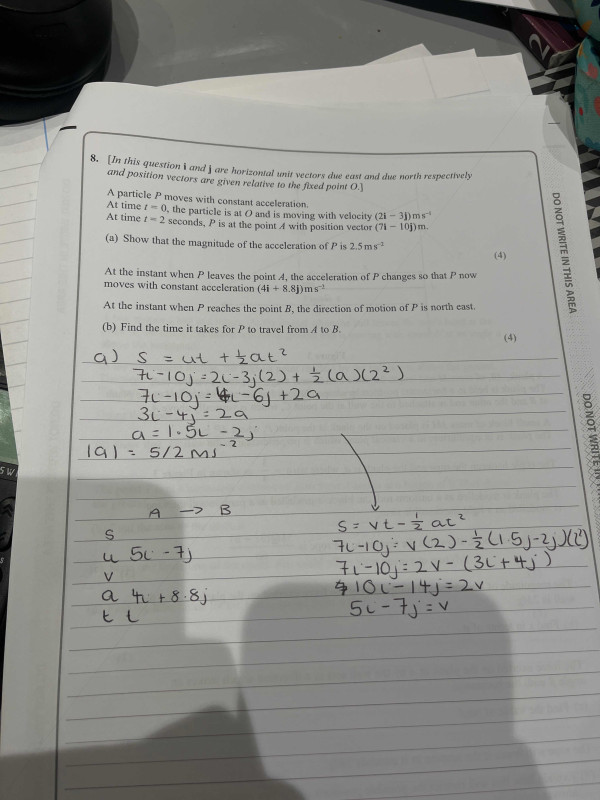
In this question i and j are horizontal unit vectors due east and due north respectively and position vectors are given relative to the fixed point O. A particle P moves with constant acceleration. At time t = 0, the particle is at O and is moving with velocity (2i - 3j) m s⁻¹. At time t = 2 seconds, P is at the point A with position vector (7i - 10j) m. (a) Show that the magnitude of the acceleration of P is 2.5 m s⁻². (4) At the instant when P leaves the point A, the acceleration of P changes so that P now moves with constant acceleration (4i + 8.8j) m s⁻². At the instant when P reaches the point B, the direction of motion of P is north east. (b) Find the time it takes for P to travel from A to B. (4)
Correct Answer
(a) Proven as required; (b) t = 2.5 s
Detailed Solution Steps
1
### Part (a) Step 1: Use the constant acceleration position vector formula\nThe position vector formula for constant acceleration is: $\\mathbf{s} = \\mathbf{u}t + \\frac{1}{2}\\mathbf{a}t^2$, where $\\mathbf{s}$ is position vector, $\\mathbf{u}$ is initial velocity, $\\mathbf{a}$ is acceleration, and $t$ is time.
2
### Part (a) Step 2: Substitute known values to solve for $\\mathbf{a}$\nSubstitute $\\mathbf{s} = 7\\mathbf{i}-10\\mathbf{j}$, $\\mathbf{u}=2\\mathbf{i}-3\\mathbf{j}$, $t=2$ into the formula:\n$7\\mathbf{i}-10\\mathbf{j} = (2\\mathbf{i}-3\\mathbf{j})(2) + \\frac{1}{2}\\mathbf{a}(2)^2$\nSimplify the right-hand side: $4\\mathbf{i}-6\\mathbf{j} + 2\\mathbf{a}$\nRearrange to solve for $\\mathbf{a}$:\n$2\\mathbf{a} = (7\\mathbf{i}-10\\mathbf{j}) - (4\\mathbf{i}-6\\mathbf{j}) = 3\\mathbf{i}-4\\mathbf{j}$\n$\\mathbf{a} = 1.5\\mathbf{i}-2\\mathbf{j}$
3
### Part (a) Step 3: Calculate the magnitude of acceleration\nThe magnitude of a vector $p\\mathbf{i}+q\\mathbf{j}$ is $|p\\mathbf{i}+q\\mathbf{j}| = \\sqrt{p^2+q^2}$.\nSubstitute $p=1.5$, $q=-2$:\n$|\\mathbf{a}| = \\sqrt{(1.5)^2 + (-2)^2} = \\sqrt{2.25 + 4} = \\sqrt{6.25} = 2.5$ m s⁻², which matches the required result.
4
### Part (b) Step 1: Find the velocity of P at point A\nUse the velocity formula $\\mathbf{v}_A = \\mathbf{u} + \\mathbf{a}t$\nSubstitute $\\mathbf{u}=2\\mathbf{i}-3\\mathbf{j}$, $\\mathbf{a}=1.5\\mathbf{i}-2\\mathbf{j}$, $t=2$:\n$\\mathbf{v}_A = (2\\mathbf{i}-3\\mathbf{j}) + (1.5\\mathbf{i}-2\\mathbf{j})(2) = 2\\mathbf{i}-3\\mathbf{j} + 3\\mathbf{i}-4\\mathbf{j} = 5\\mathbf{i}-7\\mathbf{j}$
5
### Part (b) Step 2: Define velocity at point B and use the north-east direction condition\nLet $t$ be the time from A to B. The velocity at B is $\\mathbf{v}_B = \\mathbf{v}_A + \\mathbf{a}_{new}t$, where $\\mathbf{a}_{new}=4\\mathbf{i}+8.8\\mathbf{j}$.\nNorth-east direction means the i and j components of $\\mathbf{v}_B$ are equal: $\\mathbf{v}_B = k\\mathbf{i}+k\\mathbf{j}$ for some scalar $k$.\nSubstitute into the velocity formula:\n$k\\mathbf{i}+k\\mathbf{j} = (5\\mathbf{i}-7\\mathbf{j}) + (4\\mathbf{i}+8.8\\mathbf{j})t$\nEquate i and j components:\n1. $k = 5 + 4t$\n2. $k = -7 + 8.8t$
6
### Part (b) Step 3: Solve for t\nSet the two expressions for $k$ equal:\n$5 + 4t = -7 + 8.8t$\nRearrange: $4.8t = 12$\nSolve for t: $t = \\frac{12}{4.8} = 2.5$ s
Knowledge Points Involved
1
Constant Acceleration Vectors for Motion
For particle motion in 2D, the vector equations of motion are $\\mathbf{s} = \\mathbf{u}t + \\frac{1}{2}\\mathbf{a}t^2$ and $\\mathbf{v} = \\mathbf{u} + \\mathbf{a}t$, where $\\mathbf{s}$ is position vector, $\\mathbf{u}$ is initial velocity vector, $\\mathbf{v}$ is final velocity vector, $\\mathbf{a}$ is constant acceleration vector, and $t$ is time. These extend 1D constant acceleration equations to 2D by using vector components for east (i) and north (j) directions.
2
Magnitude of a 2D Vector
For a vector $\\mathbf{v} = p\\mathbf{i} + q\\mathbf{j}$, its magnitude (size) is calculated using the Pythagorean theorem: $|\\mathbf{v}| = \\sqrt{p^2 + q^2}$. This gives the scalar value of the vector's length, used here to find the magnitude of acceleration.
3
Direction of Motion from Velocity Vectors
The direction of a particle's motion is given by its velocity vector. A north-east direction means the east (i) and north (j) components of the velocity vector are equal, as north-east is at a 45° angle to both axes, so the ratio of the components is 1:1.
Loading solution...