AI Math Solver
Resources
Questions
Pricing
Login
Register
Home
>
Questions
>
Accounting: Asset and Liability Category Changes for Stock, Debt Payment, and Receivables Scenarios
Accounting
High School Grade 11/12 (or College Introductory Accounting)
Question Content
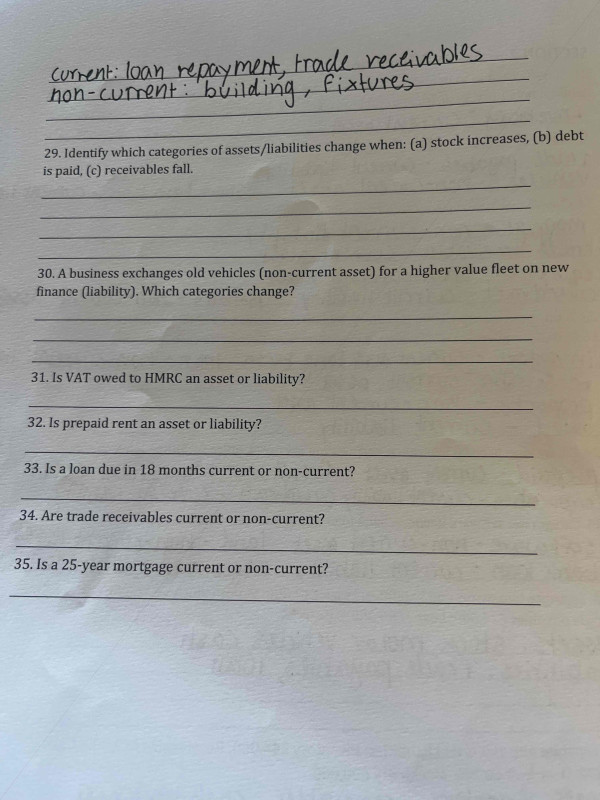
Identify which categories of assets/liabilities change when: (a) stock increases, (b) debt is paid, (c) receivables fall.
Correct Answer
(a) Current Assets increase; (b) Current Liabilities decrease and Current Assets decrease; (c) Current Assets decrease and Current Assets increase (cash/bank)
Detailed Solution Steps
1
Step 1: Analyze scenario (a): Stock (inventory) is a current asset. When stock increases, the only category affected is Current Assets, which rises in value.
2
Step 2: Analyze scenario (b): Paying debt typically uses cash (a current asset) to settle a liability (usually a current liability like accounts payable or short-term debt). So Current Assets decrease, and Current Liabilities decrease.
3
Step 3: Analyze scenario (c): Receivables (trade receivables) are current assets. When receivables fall, it means cash is received from customers, so one current asset (receivables) decreases while another current asset (cash/bank) increases.
Knowledge Points Involved
1
Current Assets Classification
Current assets are assets expected to be converted to cash, sold, or consumed within one year or the operating cycle of the business, whichever is longer. Examples include inventory (stock), cash, trade receivables, and prepaid expenses. They are used to fund day-to-day operations.
2
Current Liabilities Classification
Current liabilities are obligations due to be settled within one year or the operating cycle. Examples include accounts payable, short-term loans, and VAT owed. They represent short-term financial obligations of a business.
3
Double-Entry Bookkeeping Basics
Most accounting transactions affect at least two accounts. For example, paying debt reduces both cash (asset) and the debt account (liability); collecting receivables moves value from receivables to cash, both current assets.
Loading solution...