AI Math Solver
Resources
Questions
Pricing
Login
Register
Home
>
Questions
>
Accounting: Asset and Liability Changes for Vehicle Exchange with New Finance
Accounting
High School Grade 11/12 (or College Introductory Accounting)
Question Content
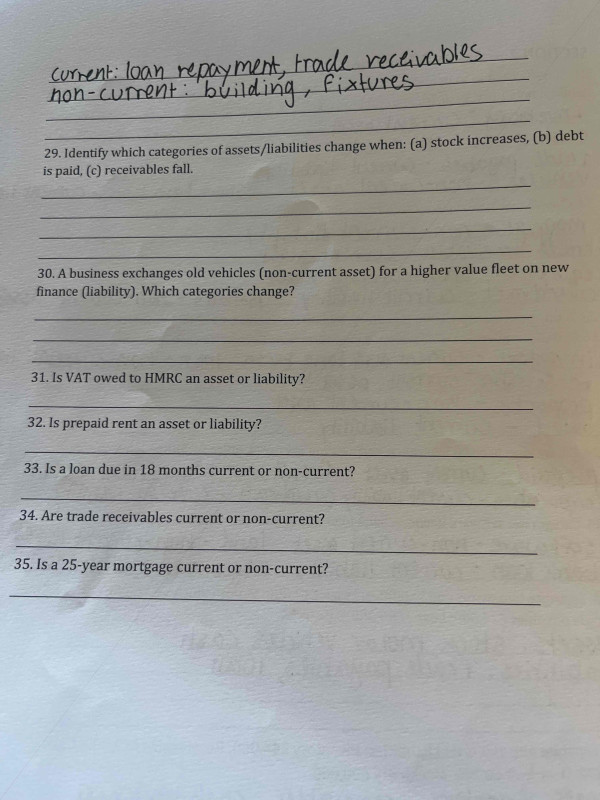
A business exchanges old vehicles (non-current asset) for a higher value fleet on new finance (liability). Which categories change?
Correct Answer
Non-Current Assets increase, Non-Current Liabilities increase, and Non-Current Assets decrease (old vehicles removed)
Detailed Solution Steps
1
Step 1: Identify the old vehicles: They are a non-current asset, so removing them decreases the Non-Current Assets category.
2
Step 2: Identify the new fleet: It is a non-current asset, so adding it increases the Non-Current Assets category.
3
Step 3: Identify the new finance: The new liability used to cover the higher value is a long-term (non-current) liability, so Non-Current Liabilities increase.
Knowledge Points Involved
1
Non-Current Liabilities Classification
Non-current liabilities are long-term financial obligations due to be settled beyond one year. Examples include long-term loans, mortgages, and finance leases for business assets.
2
Asset Exchange with Financing
When an asset is exchanged for a higher-value asset with financing, the old asset is derecognized, the new asset is recognized at its fair value, and the difference is recorded as a new long-term liability.
Loading solution...