AI Math Solver
Resources
Questions
Pricing
Login
Register
Home
>
Questions
>
Calculate Compound Interest: £600 Loan at 24% Annual Rate for 12 Years
Mathematics
Grade 9 of Junior High School
Question Content
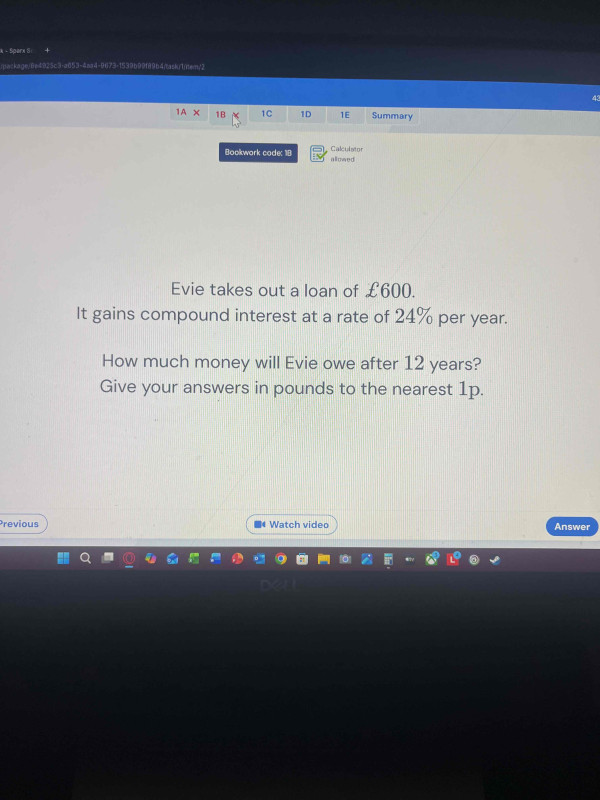
Evie takes out a loan of £600. It gains compound interest at a rate of 24% per year. How much money will Evie owe after 12 years? Give your answers in pounds to the nearest 1p.
Correct Answer
£6780.57
Detailed Solution Steps
1
Step 1: Recall the compound interest formula: \\(A = P(1 + r)^t\\), where \\(A\\) is the final amount owed, \\(P\\) is the principal (initial loan amount), \\(r\\) is the annual interest rate in decimal form, and \\(t\\) is the time in years.
2
Step 2: Identify the values from the problem: \\(P = £600\\), \\(r = 24\\% = 0.24\\), \\(t = 12\\) years.
3
Step 3: Substitute the values into the formula: \\(A = 600(1 + 0.24)^{12}\\).
4
Step 4: Calculate \\(1.24^{12}\\) first. Using a calculator, \\(1.24^{12} \\approx 11.30095\\).
5
Step 5: Multiply the result by the principal: \\(A = 600 \\times 11.30095 \\approx 6780.57\\).
6
Step 6: Round the result to the nearest 1p, which gives £6780.57.
Knowledge Points Involved
1
Compound Interest Formula
The formula \\(A = P(1 + r)^t\\) calculates the final amount \\(A\\) of an investment or loan with compound interest. \\(P\\) is the initial principal, \\(r\\) is the annual interest rate (converted to a decimal), and \\(t\\) is the number of compounding periods (years, in this case). It differs from simple interest because it calculates interest on both the original principal and the accumulated interest from previous periods, leading to exponential growth of the amount owed or earned.
2
Percentage to Decimal Conversion
To use percentages in mathematical calculations, they must be converted to decimals by dividing the percentage value by 100. For example, 24% becomes 0.24. This conversion is essential for substituting interest rates into financial formulas like the compound interest equation.
3
Rounding to the Nearest Penny
When working with currency, results are rounded to two decimal places (nearest 1p). If the third decimal place is 5 or higher, the second decimal place is rounded up; if it is less than 5, the second decimal place stays the same. This ensures the final amount is presented in a standard, practical currency format.
Loading solution...