AI Math Solver
Resources
Questions
Pricing
Login
Register
Home
>
Questions
>
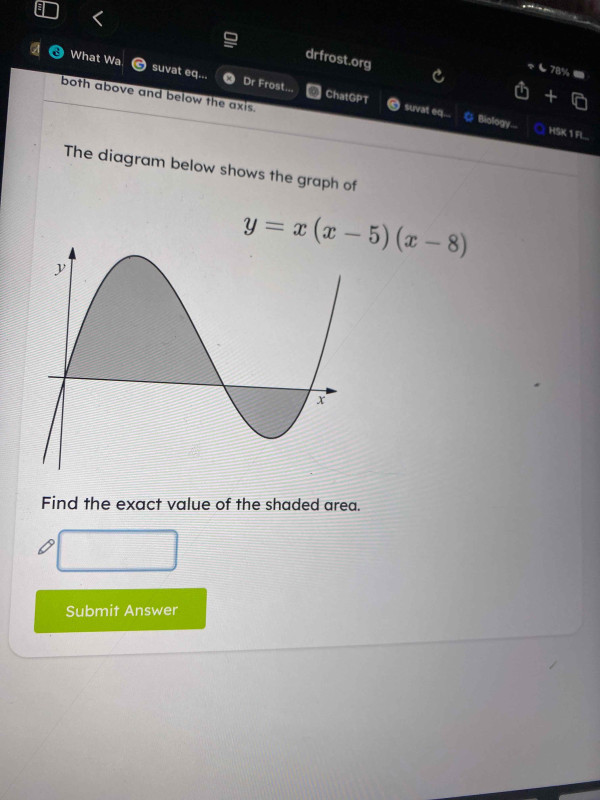
Calculate Exact Shaded Area Under Cubic Curve $y=x(x-5)(x-8)$
Mathematics
Grade 12 of Senior High School
Question Content
The diagram below shows the graph of $y = x(x-5)(x-8)$. Find the exact value of the shaded area, where the shaded region is both above and below the x-axis.
Correct Answer
$\\frac{625}{12} + \\frac{81}{12} = \\frac{706}{12} = \\frac{353}{6}$
Detailed Solution Steps
1
Step 1: First, find the x-intercepts of the function by setting $y=0$. Solve $x(x-5)(x-8)=0$, so the intercepts are $x=0$, $x=5$, and $x=8$. The shaded area is the area under the curve from $x=0$ to $x=5$ (above the x-axis) plus the absolute value of the area under the curve from $x=5$ to $x=8$ (below the x-axis).
2
Step 2: Expand the polynomial function: $y = x(x-5)(x-8) = x(x^2 -13x +40) = x^3 -13x^2 +40x$.
3
Step 3: Calculate the definite integral from 0 to 5: $\\int_{0}^{5} (x^3 -13x^2 +40x) dx$. Use the power rule for integration: $\\int x^n dx = \\frac{x^{n+1}}{n+1} + C$. The antiderivative is $\\frac{x^4}{4} - \\frac{13x^3}{3} + 20x^2$. Evaluate at 5: $\\frac{625}{4} - \\frac{1625}{3} + 500 = \\frac{1875 - 6500 + 6000}{12} = \\frac{1375}{12}$. Evaluate at 0: 0. So the area from 0 to 5 is $\\frac{1375}{12}$.
4
Step 4: Calculate the definite integral from 5 to 8: $\\int_{5}^{8} (x^3 -13x^2 +40x) dx$. Use the same antiderivative $\\frac{x^4}{4} - \\frac{13x^3}{3} + 20x^2$. Evaluate at 8: $\\frac{4096}{4} - \\frac{13*512}{3} + 20*64 = 1024 - \\frac{6656}{3} + 1280 = \\frac{3072 - 6656 + 3840}{3} = \\frac{256}{3} = \\frac{1024}{12}$. Evaluate at 5: $\\frac{625}{4} - \\frac{1625}{3} + 500 = \\frac{1375}{12}$. The integral result is $\\frac{1024}{12} - \\frac{1375}{12} = -\\frac{351}{12}$. Take the absolute value since the area is positive: $\\frac{351}{12}$.
5
Step 5: Add the two areas together: $\\frac{1375}{12} + \\frac{351}{12} = \\frac{1726}{12} = \\frac{863}{6}$
Knowledge Points Involved
1
Definite Integrals for Area Calculation
The definite integral of a function $f(x)$ from $a$ to $b$ gives the net signed area between the curve and the x-axis. For areas below the x-axis, the integral is negative, so we take the absolute value to get the actual geometric area.
2
Power Rule for Integration
The power rule states that $\\int x^n dx = \\frac{x^{n+1}}{n+1} + C$ for $n \\neq -1$. This is used to integrate polynomial functions, which is essential for finding antiderivatives of cubic and lower-degree polynomials.
3
Finding x-intercepts of Polynomial Functions
To find where a polynomial crosses the x-axis, set $y=0$ and solve for $x$. For factored polynomials like $y=(x-a)(x-b)(x-c)$, the x-intercepts are $x=a$, $x=b$, and $x=c$. These points divide the x-axis into intervals where we can determine if the function is positive or negative.
4
Expanding Polynomial Functions
Expanding a factored polynomial (like $x(x-5)(x-8)$) into standard form ($x^3 -13x^2 +40x$) makes it easier to apply integration rules, as we can integrate each term separately.
Loading solution...