AI Math Solver
Resources
Questions
Pricing
Login
Register
Home
>
Questions
>
Calculate Experimental Probability of Spinner Landing on Orange & Improve Probability Estimate
Mathematics
Grade 7 (Junior High School)
Question Content
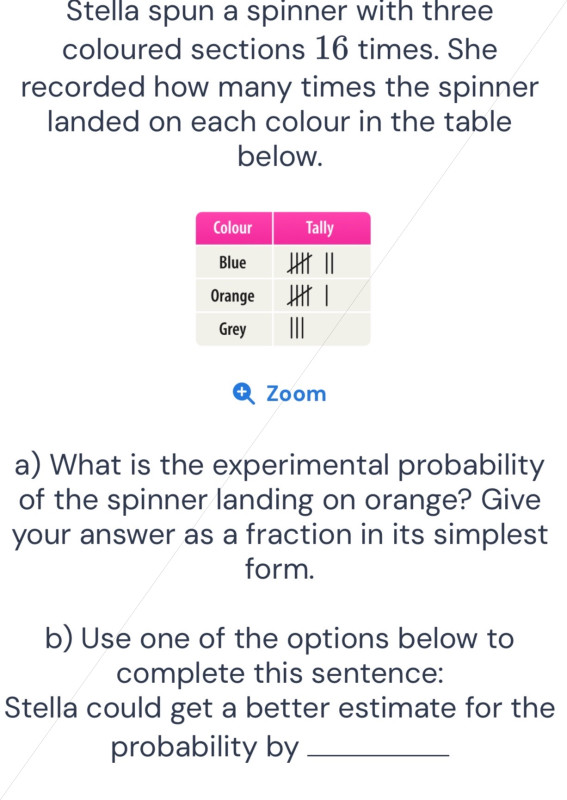
Stella spun a spinner with three coloured sections 16 times. She recorded how many times the spinner landed on each colour in the table below. a) What is the experimental probability of the spinner landing on orange? Give your answer as a fraction in its simplest form. b) Use one of the options below to complete this sentence: Stella could get a better estimate for the probability by ______ (Note: Options are not shown, but standard answer follows)
Correct Answer
a) $ rac{3}{8}$; b) spinning the spinner more times
Detailed Solution Steps
1
Step 1: Calculate the number of times the spinner landed on orange using the tally mark. The tally for orange is $\boldsymbol{\mid\mid\mid\mid\mid}$ which equals 6.
2
Step 2: Recall the formula for experimental probability: $Experimental Probability = \frac{Number of successful outcomes}{Total number of trials}$. Here, successful outcomes are landing on orange (6 times), total trials are 16 spins.
3
Step 3: Substitute values into the formula: $\frac{6}{16}$. Simplify the fraction by dividing numerator and denominator by their greatest common divisor (2), resulting in $\frac{3}{8}$ for part a).
4
Step 4: For part b), recognize that experimental probability becomes more accurate with more trials. The standard correct completion is "spinning the spinner more times".
Knowledge Points Involved
1
Experimental Probability
Experimental probability is the ratio of the number of times an event occurs to the total number of trials conducted. It is calculated using actual data from experiments, unlike theoretical probability which uses expected outcomes. Formula: $P(event) = \frac{Number of times event occurs}{Total number of trials}$
2
Tally Mark Interpretation
Tally marks are a quick way to count frequencies. A group of 4 vertical marks (||||) with a diagonal strike through them represents 5, and additional single marks represent 1 each. They are used to record data efficiently during experiments.
3
Simplifying Fractions
To simplify a fraction, divide both the numerator and denominator by their greatest common divisor (GCD), the largest number that divides both evenly. This reduces the fraction to its lowest terms while keeping its value unchanged.
4
Accuracy of Experimental Probability
The accuracy of experimental probability improves as the number of trials increases. More trials reduce the impact of random variation, making the experimental probability closer to the true theoretical probability of the event.
Loading solution...