AI Math Solver
Resources
Questions
Pricing
Login
Register
Home
>
Questions
>
Calculate Probability of Failing At Least One Test Using Frequency Tree
Mathematics
Grade 9 of Junior High School
Question Content
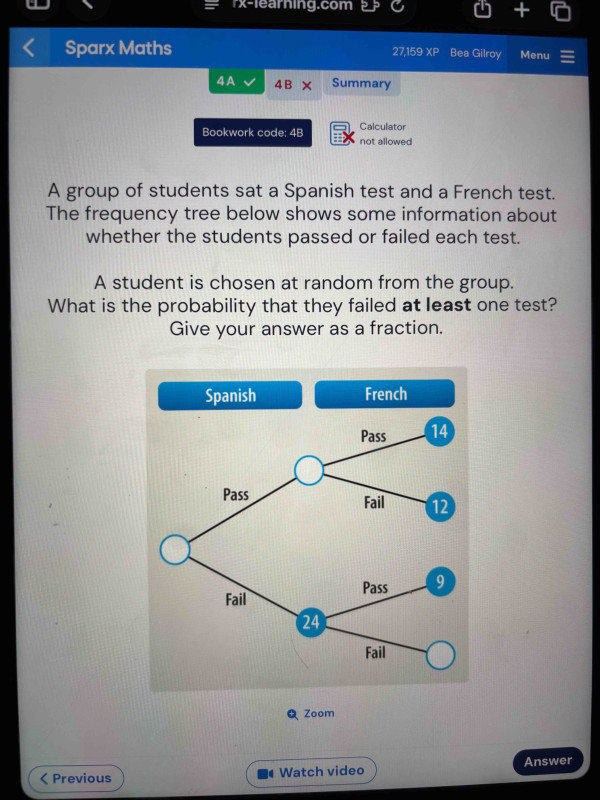
A group of students sat a Spanish test and a French test. The frequency tree below shows some information about whether the students passed or failed each test. A student is chosen at random from the group. What is the probability that they failed at least one test? Give your answer as a fraction.
Correct Answer
\(\frac{45}{59}\)
Detailed Solution Steps
1
Step 1: Calculate the total number of students who passed the Spanish test. From the frequency tree, 14 passed French and 12 failed French among those who passed Spanish, so this total is \(14 + 12 = 26\).
2
Step 2: Calculate the total number of students in the group. We know 26 passed Spanish, and 24 failed Spanish, so total students are \(26 + 24 = 59\).
3
Step 3: Calculate the number of students who failed at least one test. First, find the number of students who passed both tests: that is the 14 students who passed Spanish and French. Then subtract this from the total number of students: \(59 - 14 = 45\). Alternatively, calculate directly: students who failed Spanish (24) + students who passed Spanish but failed French (12) = \(24 + 12 = 45\).
4
Step 4: Calculate the probability by dividing the number of students who failed at least one test by the total number of students: \(\frac{45}{59}\).
Knowledge Points Involved
1
Frequency Trees
A frequency tree is a visual tool used to organize and display categorical data, showing the number of observations in each subgroup. It helps break down totals into smaller, related groups to analyze relationships between different events (like test results here).
2
Probability Calculation for Compound Events
For probability questions involving "at least one" outcomes, two common methods are used: 1) Calculate the number of favorable outcomes directly, or 2) Use the complement rule: \(P(\text{at least one failure}) = 1 - P(\text{no failures, i.e., passed both tests})\). This simplifies calculation by focusing on the opposite, easier-to-find event.
3
Fractional Probability
When calculating probability for a random selection, the probability is expressed as a fraction where the numerator is the number of favorable outcomes, and the denominator is the total number of possible outcomes. The fraction should be in simplest form if possible; here, 45 and 59 share no common factors other than 1, so it is already simplified.
Loading solution...