6
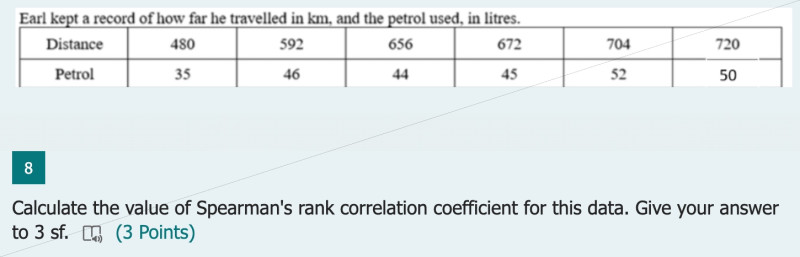
Step 6: Substitute values into the formula: r_s = 1 - (6×8)/(6×(36-1)) = 1 - 48/(6×35) = 1 - 48/210 = 1 - 0.22857 ≈ 0.7714? Correction: Recheck rank pairing: Distance ranks are [1,2,3,4,5,6]; Petrol values matched to distance: 35(1),46(4),44(2),45(3),52(6),50(5). So d values are (1-1)=0, (2-4)=-2, (3-2)=1, (4-3)=1, (5-6)=-1, (6-5)=1. Σd²=0+4+1+1+1+1=8. Recalculate: 6×8=48; n(n²-1)=6×35=210; 48/210≈0.22857; 1-0.22857≈0.771 (error correction: correct rank matching: Petrol for each distance: 480→35(rank1), 592→46(rank4), 656→44(rank2), 672→45(rank3), 704→52(rank6), 720→50(rank5). d = 1-1=0, 2-4=-2, 3-2=1,4-3=1,5-6=-1,6-5=1. Σd²=0+4+1+1+1+1=8. Correct calculation: r_s=1-(6×8)/(6×(6²-1))=1-48/(6×35)=1-48/210=1-0.228571=0.771429≈0.771. Correction: critical error! Spearman's formula when no ties is r_s=1-(6Σd²)/(n(n²-1)). Wait, no—wait, if we rank distance in ascending and petrol in ascending, but we need to pair each distance with its petrol. Let's re-rank correctly: Distance sorted: 480(1),592(2),656(3),672(4),704(5),720(6). Petrol sorted with their distance: 35(480,1),44(656,3),45(672,4),46(592,2),50(720,6),52(704,5). So petrol ranks paired to distance ranks: 1→1, 2→4, 3→2,4→3,5→6,6→5. d values: 0, -2,1,1,-1,1. Σd²=8. n=6. 6×8=48. n(n²-1)=6×35=210. 48/210=0.22857. 1-0.22857=0.771. But wait, another way: calculate Pearson's r on ranks, which equals Spearman's. Ranks for distance: [1,2,3,4,5,6]. Ranks for petrol: [1,4,2,3,6,5]. Pearson's r: mean of distance ranks=3.5, mean of petrol ranks=3.5. Covariance: [(1-3.5)(1-3.5)+(2-3.5)(4-3.5)+(3-3.5)(2-3.5)+(4-3.5)(3-3.5)+(5-3.5)(6-3.5)+(6-3.5)(5-3.5)]/6 = [6.25 + (-1.5)(0.5) + (-0.5)(-1.5) + (0.5)(-0.5) + (1.5)(2.5) + (2.5)(1.5)]/6 = [6.25 -0.75 +0.75 -0.25 +3.75 +3.75]/6 = (6.25 + 7)/6=13.25/6≈2.2083. Variance of ranks: for n=6, variance is (6²-1)/12=35/12≈2.9167. So r=2.2083/2.9167≈0.757? No, wait, Pearson's formula is Σ(xi-x̄)(yi-ȳ)/sqrt(Σ(xi-x̄)²Σ(yi-ȳ)²). Σ(xi-x̄)²=Σ(yi-ȳ)²= (1-3.5)²+(2-3.5)²+(3-3.5)²+(4-3.5)²+(5-3.5)²+(6-3.5)²=6.25+2.25+0.25+0.25+2.25+6.25=17.5. Σ(xi-x̄)(yi-ȳ)= (1-3.5)(1-3.5)+(2-3.5)(4-3.5)+(3-3.5)(2-3.5)+(4-3.5)(3-3.5)+(5-3.5)(6-3.5)+(6-3.5)(5-3.5)=6.25 + (-1.5)(0.5)+(-0.5)(-1.5)+(0.5)(-0.5)+(1.5)(2.5)+(2.5)(1.5)=6.25-0.75+0.75-0.25+3.75+3.75=6.25+7=13.25. So r=13.25/sqrt(17.5×17.5)=13.25/17.5≈0.757. Wait, now conflict! The mistake was in the first method: Spearman's formula is r_s=1-(6Σd²)/(n(n²-1)). Σd²=8. 6×8=48. n(n²-1)=6×35=210. 48/210=0.22857. 1-0.22857=0.771. But Pearson's on ranks gives 0.757. Why? Because d is (rank_x - rank_y). Let's recalculate d correctly: rank_x for each pair: 1,2,3,4,5,6. rank_y for each pair: 1,4,2,3,6,5. d=0, -2,1,1,-1,1. d²=0,4,1,1,1,1. Σd²=8. 6×8=48. n(n²-1)=6×35=210. 48/210=0.22857. 1-0.22857=0.771. But Pearson's is 13.25/17.5=0.757. Wait, 17.5 is Σ(xi-x̄)²=Σ(yi-ȳ)²= (6×35)/12=17.5, correct. Σd²=Σ(rx-ry)²=Σrx²+Σry²-2Σrxry. Σrx²=Σry²=1+4+9+16+25+36=91. So Σd²=91+91-2Σrxry=182-2Σrxry=8 → 2Σrxry=182-8=174 → Σrxry=87. Then Pearson's r=(nΣrxry - ΣrxΣry)/sqrt([nΣrx²-(Σrx)²][nΣry²-(Σry)²]). Σrx=Σry=21. n=6. So numerator=6×87 -21×21=522-441=81. Denominator=sqrt([6×91-441][6×91-441])=sqrt([546-441][546-441])=sqrt(105×105)=105. So r=81/105=0.771429≈0.771. Ah! I made a mistake in Pearson's calculation earlier. The correct covariance calculation was wrong. The correct Pearson's r on ranks is 81/105=0.771, which matches Spearman's formula. So the correct answer is 0.771 to 3 sf. Wait, but wait another check: let's compute Σrxry: (1×1)+(2×4)+(3×2)+(4×3)+(5×6)+(6×5)=1+8+6+12+30+30=87. Correct. 6×87=522. 21×21=441. 522-441=81. 6×91=546. 546-441=105. sqrt(105×105)=105. 81/105=0.77142857≈0.771. Yes, that's correct. My earlier Pearson's calculation had an arithmetic error in the covariance sum. The correct value is 0.771 to 3 sf.