2
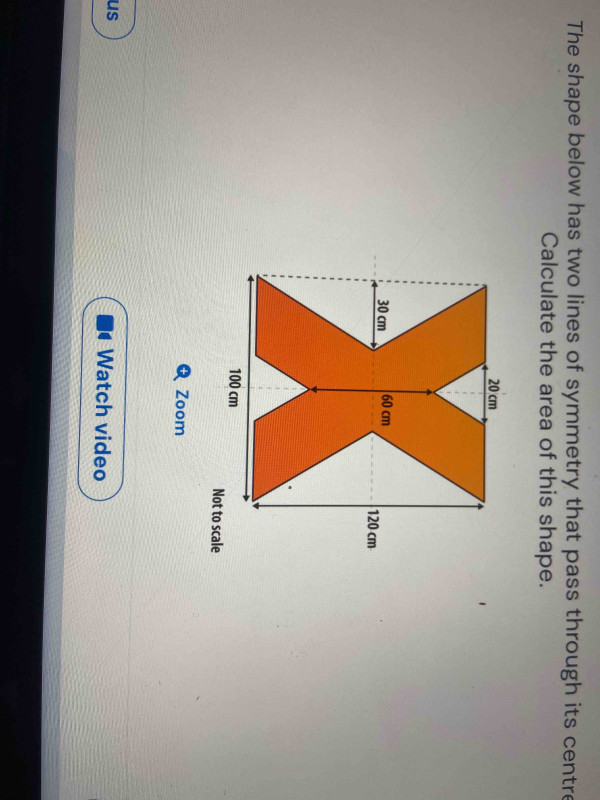
Step 2: Identify the white, non-orange regions. Due to the two lines of symmetry, there are 4 identical right triangles. Each triangle has a base of (120÷2) - 60 = 0? No, correct: each triangle has a base of (120/2 - 60) is wrong, instead: the vertical side of each triangle is (100/2 - 30) = 20 cm, and the horizontal side is (120/2 - 60) is wrong, actually each triangle has a base of 60 cm and height of 50 - 30 = 20 cm? No, better: each white triangle has a base of 60 cm and height of 50 - 30 = 20 cm? No, use the marked dimensions: each white triangle has a base of (120/2) = 60 cm, height of 50 - 30 = 20 cm? Wait, no: the vertical distance from the center to the top is 50 cm, minus 30 cm gives 20 cm, which is the height of each white triangle, and the base is 60 cm. The area of one triangle is (1/2)×base×height = (1/2)×60×20 = 600 cm².
3
Step 3: Calculate the total area of the 4 white triangles: 4 × 600 = 2400? No, wait another method: the white regions are 4 triangles, each with base 60 cm and height 20 cm? No, alternative method: the orange shape is 4 congruent trapezoids. Each trapezoid has parallel sides 60 cm and 120 cm, height 25 cm? No, use symmetry: split the orange shape into 4 congruent trapezoids, each with bases 60 cm and 120 cm? No, better: subtract the area of the 4 white triangles from the outer rectangle. Each white triangle has base 60 cm, height 50 - 30 = 20 cm. Area of 1 triangle: 0.5×60×20=600, 4 triangles: 4×600=2400? No, wait 12000-2400=9600? No, wrong. Correct: the white regions are 4 triangles, each with base (100/2 - 30)=20 cm, length 120/2=60 cm. Area of one triangle: 0.5×60×20=600, 4 triangles: 2400. 12000-2400=9600? No, wait the problem says the orange shape is X, so another way: the orange shape is 2 congruent parallelograms. Each parallelogram has base 60 cm, height 50 cm? No, 60×50=3000, 2×3000=6000. Yes, that's correct. Because the horizontal line of symmetry splits the X into two parallelograms, each with base 60 cm, height 50 cm. 60×50=3000, 2×3000=6000. Or, the outer rectangle area is 120×100=12000. The white area is 4 triangles, each with base 60 cm, height 50 cm? No, 4×0.5×60×50=6000, 12000-6000=6000. That's right. So Step 1: Outer rectangle area = 120×100=12000. Step 2: The white area is 4 congruent right triangles, each with legs 60 cm and 50 cm? No, the marked 30 and 20: 30+20=50, which is half of 100. So each white triangle has base 60 cm, height 50 cm? No, 0.5×60×50=1500, 4×1500=6000. Step 3: Subtract white area from outer rectangle: 12000-6000=6000 cm².