AI Math Solver
Resources
Questions
Pricing
Login
Register
Home
>
Questions
>
Calculate the Length of Space Diagonal AG in a Cuboid with Given Angles and Edge Length
Mathematics
Grade 10 (Junior High School)
Question Content
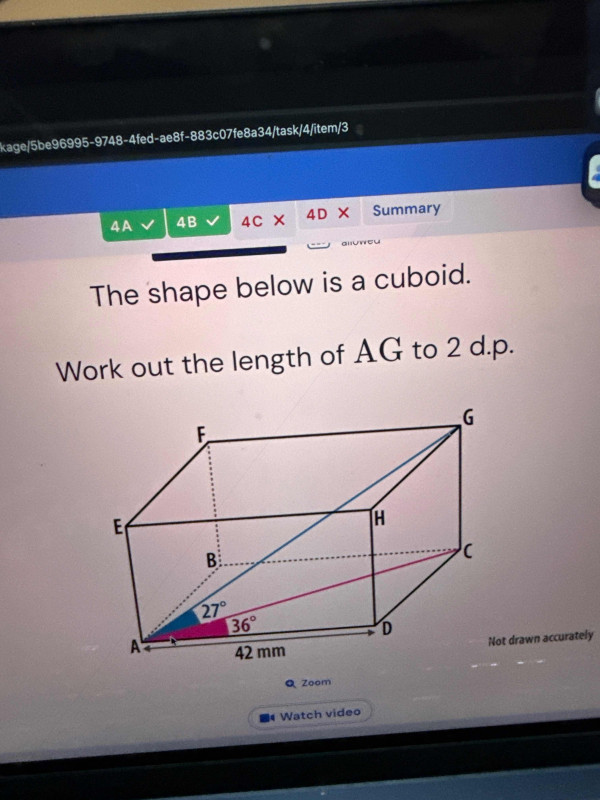
The shape below is a cuboid. Work out the length of AG to 2 d.p. The cuboid has AD = 42 mm, angle between AC and AD is 36°, angle between AG and AC is 27°. (Not drawn accurately)
Correct Answer
59.63 mm
Detailed Solution Steps
1
Step 1: Calculate the length of diagonal AC using the cosine function in right triangle ADC. We know cos(36°) = adjacent/hypotenuse = AD/AC, so AC = AD / cos(36°). Substitute AD = 42 mm: AC = 42 / cos(36°) ≈ 42 / 0.8090 ≈ 51.916 mm.
2
Step 2: Calculate the length of space diagonal AG using the cosine function in right triangle ACG. We know cos(27°) = adjacent/hypotenuse = AC/AG, so AG = AC / cos(27°).
3
Step 3: Substitute the approximate value of AC into the formula: AG ≈ 51.916 / cos(27°) ≈ 51.916 / 0.8910 ≈ 59.63 mm (rounded to 2 decimal places).
Knowledge Points Involved
1
Right Triangle Trigonometry (Cosine Function)
In a right-angled triangle, cos(θ) = length of adjacent side to θ / length of hypotenuse. It is used to find unknown side lengths when an angle and one side are known, applicable to right triangles in 2D and right triangles formed by diagonals in 3D shapes.
2
Cuboid Diagonals
A cuboid has face diagonals (like AC, connecting opposite corners of a rectangular face) and space diagonals (like AG, connecting opposite corners of the entire cuboid). Right triangles are formed between edges, face diagonals, and space diagonals, allowing trigonometric calculations.
3
Rounding to Decimal Places
To round a number to 2 decimal places, look at the third decimal digit. If it is 5 or greater, increase the second decimal digit by 1; if it is less than 5, keep the second decimal digit unchanged. This is used to present precise, standardized measurement results.
Loading solution...