AI Math Solver
Resources
Questions
Pricing
Login
Register
Home
>
Questions
>
Calculate the Volume of Oil in a Half-Full Cylindrical Tank (Radius 100cm, Height 250cm)
Mathematics
Grade 8
Question Content
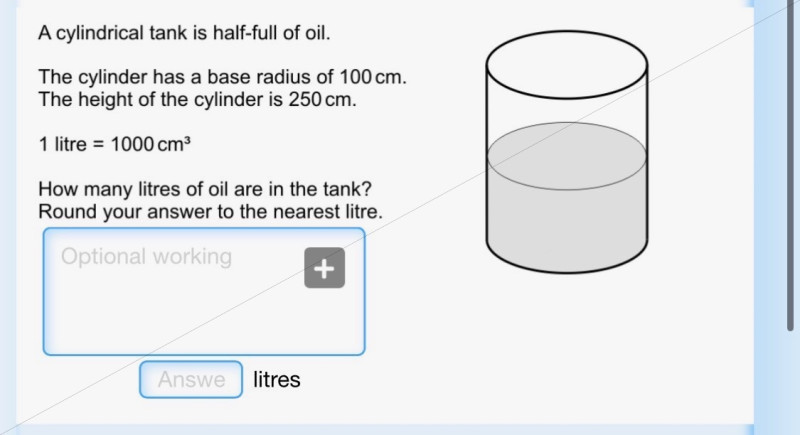
A cylindrical tank is half-full of oil. The cylinder has a base radius of 100 cm. The height of the cylinder is 250 cm. 1 litre = 1000 cm³. How many litres of oil are in the tank? Round your answer to the nearest litre.
Correct Answer
3927 litres
Detailed Solution Steps
1
Step 1: Recall the formula for the volume of a cylinder: $V = \\pi r^2 h$, where $r$ is the base radius and $h$ is the total height of the cylinder.
2
Step 2: Substitute the given values ($r=100$ cm, $h=250$ cm) into the formula to find the total volume of the cylinder: $V_{total} = \\pi \\times (100)^2 \\times 250 = \\pi \\times 10000 \\times 250 = 2500000\\pi$ cm³.
3
Step 3: Calculate the volume of the oil, since the tank is half-full: $V_{oil} = \\frac{1}{2} \\times V_{total} = \\frac{1}{2} \\times 2500000\\pi = 1250000\\pi$ cm³ ≈ 3926990.82 cm³.
4
Step 4: Convert the volume from cubic centimeters to litres using the conversion factor 1 litre = 1000 cm³: $\\text{Volume in litres} = \\frac{3926990.82}{1000} ≈ 3927$ litres.
Knowledge Points Involved
1
Volume of a Cylinder
The formula for the volume of a right circular cylinder is $V = \\pi r^2 h$, where $r$ is the length of the base radius and $h$ is the height of the cylinder. This formula calculates the total space enclosed by the cylinder, and it is derived by multiplying the area of the circular base ($\\pi r^2$) by the height of the cylinder. It is used to solve problems involving 3D cylindrical containers, pipes, and objects.
2
Unit Conversion (Volume)
Unit conversion for volume involves converting between different units of measurement for space. In this problem, we convert cubic centimeters (cm³) to litres using the conversion factor 1 litre = 1000 cm³. This is essential for solving real-world problems where measurements are given in metric units that need to be converted to a more practical unit for the context.
3
Rounding to the Nearest Whole Number
Rounding to the nearest whole number means adjusting a decimal value to the closest integer. If the decimal part is 0.5 or greater, we round up; if it is less than 0.5, we round down. This is used to present final answers in a more understandable, practical format for real-world applications.
Loading solution...