AI Math Solver
Resources
Questions
Pricing
Login
Register
Home
>
Questions
>
Calculate Volume of a Regular Hexagonal Prism with Given Side Length and Height
Mathematics
Grade 10 of Junior High School
Question Content
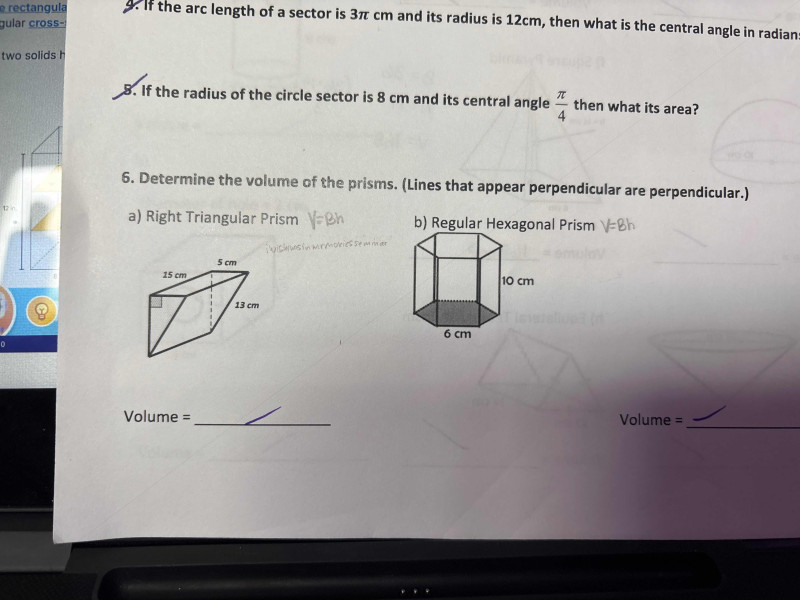
Determine the volume of the regular hexagonal prism. (Lines that appear perpendicular are perpendicular.) The prism has a regular hexagonal base with side length 6 cm, and the height of the prism is 10 cm.
Correct Answer
540\\sqrt{3}$ cm³
Detailed Solution Steps
1
Step 1: Recall the volume formula for a prism: $V = Bh$, where $B$ is the area of the base, and $h$ is the height of the prism.
2
Step 2: Calculate the area of the regular hexagonal base. A regular hexagon can be divided into 6 equilateral triangles with side length equal to the hexagon's side length. The area of one equilateral triangle is $\\frac{\\sqrt{3}}{4}s^2$, so the area of the hexagon is $6 \\times \\frac{\\sqrt{3}}{4}s^2$.
3
Step 3: Substitute $s=6$ cm into the hexagon area formula: $B = 6 \\times \\frac{\\sqrt{3}}{4} \\times 6^2 = 6 \\times \\frac{\\sqrt{3}}{4} \\times 36 = 54\\sqrt{3}$ cm².
4
Step 4: Substitute $B=54\\sqrt{3}$ cm² and prism height $h=10$ cm into the volume formula: $V = 54\\sqrt{3} \\times 10 = 540\\sqrt{3}$ cm³.
Knowledge Points Involved
1
Prism Volume Formula
The volume of any prism is given by $V = Bh$, where $B$ is the area of the prism's base (any polygon shape) and $h$ is the perpendicular distance between the two bases (also called the height of the prism). It applies to all right and oblique prisms.
2
Area of a Regular Hexagon
A regular hexagon can be split into 6 congruent equilateral triangles, each with side length equal to the hexagon's side length $s$. The area is calculated as $\\frac{3\\sqrt{3}}{2}s^2$, which is derived from multiplying the area of one equilateral triangle ($\\frac{\\sqrt{3}}{4}s^2$) by 6.
3
Area of an Equilateral Triangle
The area of an equilateral triangle with side length $s$ is $\\frac{\\sqrt{3}}{4}s^2$. It comes from applying the general triangle area formula $\\frac{1}{2} \\times base \\times height$, where the height of the equilateral triangle is $\\frac{\\sqrt{3}}{2}s$ (found using the Pythagorean theorem).
Loading solution...