AI Math Solver
Resources
Questions
Pricing
Login
Register
Home
>
Questions
>
Determine NPN Transistor Operating Mode | Electronics Circuit Problem
Electronics (Physics)
Grade 11-12 (Senior High School / Pre-University)
Question Content
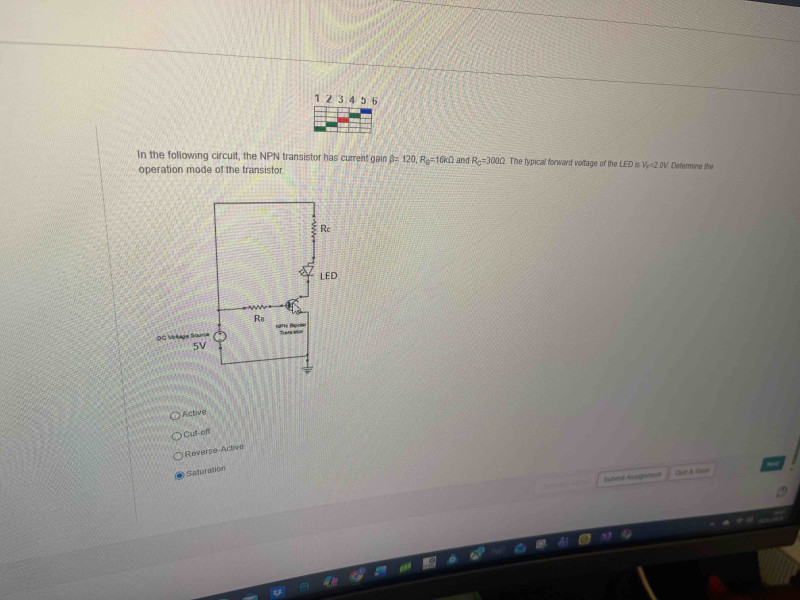
In the following circuit, the NPN transistor has current gain β=120, R_B=100kΩ and R_C=300Ω. The typical forward voltage of the LED is V_F=2.0V. Determine the operation mode of the transistor. Options: Active, Cut-off, Reverse-Active, Saturation
Correct Answer
Saturation
Detailed Solution Steps
1
Step 1: Calculate the base current (I_B). Using Ohm's Law for the base circuit: I_B = (V_S - V_BE) / R_B. Assume V_BE (base-emitter voltage for forward-biased NPN) is 0.7V, V_S=5V. So I_B = (5V - 0.7V) / 100000Ω = 4.3V / 100000Ω = 43μA.
2
Step 2: Calculate the maximum possible collector current in active mode (I_C(active)). I_C(active) = β × I_B = 120 × 43μA = 5.16mA.
3
Step 3: Calculate the collector-emitter voltage in active mode (V_CE(active)). First find the voltage drop across R_C: V_RC = I_C(active) × R_C = 5.16mA × 300Ω = 1.548V. Then V_CE(active) = V_S - V_RC - V_F = 5V - 1.548V - 2V = 1.452V.
4
Step 4: Calculate the saturation collector current (I_C(sat)). In saturation, V_CE(sat) ≈ 0.2V (typical for NPN transistors). Rearrange the collector circuit equation: I_C(sat) = (V_S - V_CE(sat) - V_F) / R_C = (5V - 0.2V - 2V) / 300Ω = 2.8V / 300Ω ≈ 9.33mA.
5
Step 5: Compare I_C(active) and I_C(sat). Since I_C(active) (5.16mA) < I_C(sat) (9.33mA), the transistor cannot reach the active mode current; instead, it will saturate, as the collector current is limited by the circuit to less than the active mode value, meaning V_CE drops to the saturation voltage.
Knowledge Points Involved
1
NPN Transistor Operating Modes
NPN transistors have 4 modes: 1. Active: Base-emitter forward biased, base-collector reverse biased; collector current is β×base current. 2. Saturation: Both junctions forward biased; collector current is limited by the external circuit, V_CE is very low (~0.2V). 3. Cut-off: Both junctions reverse biased; no current flows. 4. Reverse-Active: Base-collector forward biased, base-emitter reverse biased; used rarely, current flows in reverse direction.
2
Ohm's Law for Transistor Circuits
Ohm's Law (V=IR) is used to calculate currents and voltage drops in the base and collector circuits of a transistor. For the base circuit, it finds base current; for the collector circuit, it finds voltage drops across resistors and limits on collector current.
3
Transistor Current Gain (β)
β (DC current gain) is the ratio of collector current (I_C) to base current (I_B) in active mode, I_C=β×I_B. It describes how much the transistor amplifies the base current to produce a larger collector current, only valid in the active operating mode.
4
Saturation Condition for Transistors
A transistor enters saturation when the calculated active-mode collector current is greater than the maximum collector current possible with the external circuit (I_C(sat)). In this state, the collector-emitter voltage drops to a minimum saturation value, and the transistor acts like a closed switch.
Loading solution...