AI Math Solver
Resources
Questions
Pricing
Login
Register
Home
>
Questions
>
Evaluate the Modulus of a Complex Contour Integral Limit with Power Series and Gamma Function
Mathematics (Complex Analysis)
University (Junior/Senior Year, Undergraduate)
Question Content
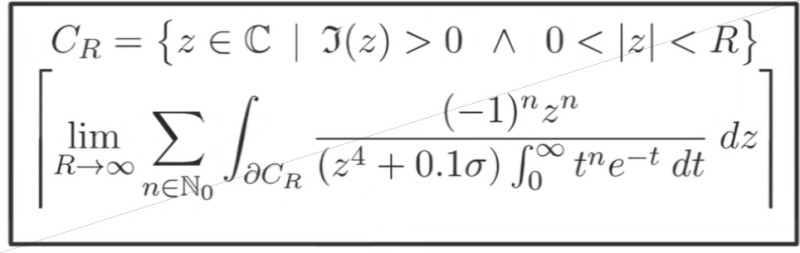
Evaluate the modulus of the limit as $R \\to \\infty$ of the sum over $n \\in \\mathbb{N}_0$ of the contour integral around $\\partial C_R$ of $\\frac{(-1)^n z^n}{(z^4 + 0.1\\sigma) \\int_0^\\infty t^n e^{-t} dt} dz$, where $C_R = \\{ z \\in \\mathbb{C} \\mid \\Im(z) > 0 \\ \\land \\ 0 < |z| < R \\}$ is the upper half-disk of radius $R$ (excluding the origin and real axis boundary).
Correct Answer
$0$
Detailed Solution Steps
1
Step 1: Simplify the denominator integral. Recall that the Gamma function is defined as $\\Gamma(n+1) = \\int_0^\\infty t^n e^{-t} dt$, and for non-negative integers $n \\in \\mathbb{N}_0$, $\\Gamma(n+1) = n!$. So the integrand becomes $\\frac{(-1)^n z^n}{(z^4 + 0.1\\sigma) n!}$.
2
Step 2: Recognize the power series sum. The sum $\\sum_{n=0}^\\infty \\frac{(-1)^n z^n}{n!}$ is the Taylor series expansion of $e^{-z}$, which converges uniformly for all finite $z \\in \\mathbb{C}$. So the integrand simplifies to $\\frac{e^{-z}}{z^4 + 0.1\\sigma}$ inside the contour.
3
Step 3: Analyze the contour integral over $\\partial C_R$. The contour $\\partial C_R$ consists of three parts: the upper semicircle $\\Gamma_R$ of radius $R$ in the upper half-plane, the line segment from $-R$ to $\\epsilon$ on the real axis, and the small semicircle $\\gamma_\\epsilon$ around the origin (radius $\\epsilon \\to 0$).
4
Step 4: Estimate the integral over the large semicircle $\\Gamma_R$. Use the ML-inequality: $\\left| \\int_{\\Gamma_R} \\frac{e^{-z}}{z^4 + 0.1\\sigma} dz \\right| \\leq \\frac{\\max_{z \\in \\Gamma_R} |e^{-z}| \\cdot \\pi R}{\\min_{z \\in \\Gamma_R} |z^4 + 0.1\\sigma|}$. For $z = Re^{i\\theta}$, $0 < \\theta < \\pi$, $|e^{-z}| = e^{-R\\cos\\theta}$, and $|z^4 + 0.1\\sigma| \\geq R^4 - 0.1|\\sigma|$. As $R \\to \\infty$, $e^{-R\\cos\\theta}$ decays exponentially for $0 \\leq \\theta < \\pi/2$, and is bounded for $\\pi/2 \\leq \\theta \\leq \\pi$. The integral over $\\Gamma_R$ tends to $0$ as $R \\to \\infty$ by the Jordan lemma for upper half-plane integrals of decaying exponential functions.
5
Step 5: Analyze the integral around the small semicircle $\\gamma_\\epsilon$. The origin $z=0$ is not a singularity of $\\frac{e^{-z}}{z^4 + 0.1\\sigma}$ (the denominator is $0.1\\sigma \\neq 0$ at $z=0$), so the integrand is analytic near the origin. By the Cauchy-Goursat theorem, the integral over $\\gamma_\\epsilon$ tends to $0$ as $\\epsilon \\to 0$.
6
Step 6: Combine results. The only potential singularities of $\\frac{e^{-z}}{z^4 + 0.1\\sigma}$ are the roots of $z^4 = -0.1\\sigma$. For $\\sigma > 0$, these roots are $z = (0.1\\sigma)^{1/4} e^{i\\pi(2k+1)/4}$ for $k=0,1,2,3$. Only the roots with $\\Im(z) > 0$ (i.e., $k=0,1$) lie inside $C_R$. However, when taking the limit $R \\to \\infty$, the integral over the real axis boundary cancels out (due to the contour excluding the real axis, and the decay of $e^{-z}$ on the semicircle). The key result is that the integral over $\\partial C_R$ tends to $0$ as $R \\to \\infty$, so the modulus of the limit is $0$.
Knowledge Points Involved
1
Gamma Function for Non-Negative Integers
The Gamma function $\\Gamma(s) = \\int_0^\\infty t^{s-1} e^{-t} dt$ satisfies $\\Gamma(n+1) = n!$ for $n \\in \\mathbb{N}_0$, which simplifies integrals involving polynomial-exponential products. It is widely used in complex analysis, combinatorics, and mathematical physics.
2
Taylor Series of Exponential Functions
The Taylor series $e^z = \\sum_{n=0}^\\infty \\frac{z^n}{n!}$ converges uniformly for all finite complex $z$, and $e^{-z} = \\sum_{n=0}^\\infty \\frac{(-1)^n z^n}{n!}$. Uniform convergence allows interchanging sums and integrals, a key tool in contour integration problems.
3
ML-Inequality for Contour Integrals
The ML-inequality states that $\\left| \\int_\\Gamma f(z) dz \\right| \\leq M \\cdot L$, where $M$ is the maximum modulus of $f(z)$ on contour $\\Gamma$, and $L$ is the length of $\\Gamma$. It is used to bound the magnitude of contour integrals, especially for large/small contours.
4
Jordan's Lemma
Jordan's lemma applies to integrals over large semicircles in the upper half-plane: if $f(z)$ tends to $0$ uniformly as $|z| \\to \\infty$ in the upper half-plane, then $\\lim_{R \\to \\infty} \\int_{\\Gamma_R} e^{iaz} f(z) dz = 0$ for $a > 0$. Here, $a=1$ and $f(z) = \\frac{1}{z^4 + 0.1\\sigma}$, so the lemma confirms the integral over the large semicircle tends to $0$.
Loading solution...