AI Math Solver
Resources
Questions
Pricing
Login
Register
Home
>
Questions
>
Find Expected Total Donation Value for 60 Donations Using a Proportional Line Graph
Mathematics
Grade 7
Question Content
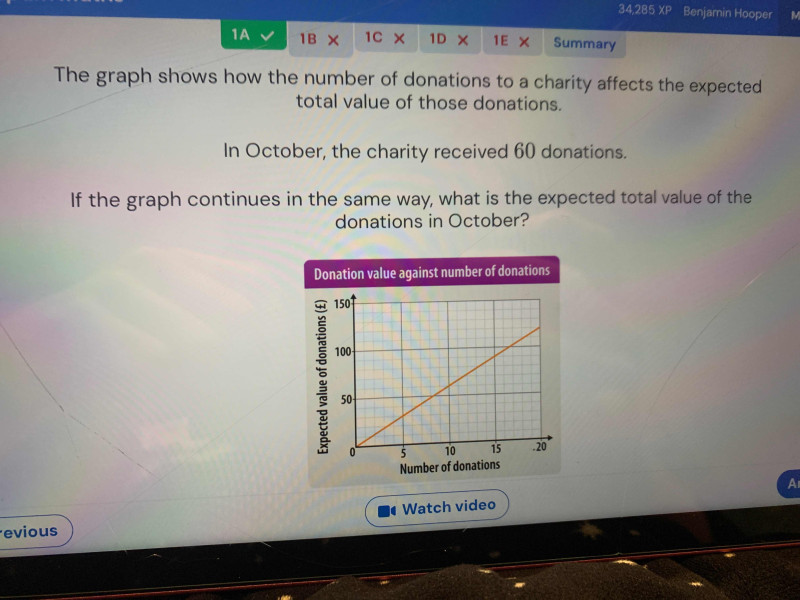
The graph shows how the number of donations to a charity affects the expected total value of those donations. In October, the charity received 60 donations. If the graph continues in the same way, what is the expected total value of the donations in October? (The provided graph is titled 'Donation value against number of donations', with x-axis labeled 'Number of donations' (0 to 20) and y-axis labeled 'Expected value of donations (£)' (0 to 150), showing a straight line passing through the origin and (20, 120))
Correct Answer
£360
Detailed Solution Steps
1
Step 1: Identify the relationship from the graph. The line is a proportional relationship (passes through (0,0)), so we can calculate the unit rate (value per donation). From the graph, 20 donations correspond to an expected value of £120.
2
Step 2: Calculate the value per single donation: Divide the total value by the number of donations: £120 ÷ 20 = £6 per donation.
3
Step 3: Calculate the total value for 60 donations: Multiply the value per donation by the number of donations: £6 × 60 = £360.
Knowledge Points Involved
1
Proportional Linear Relationships
A proportional linear relationship is a straight-line relationship that passes through the origin (0,0), meaning one quantity is a constant multiple of the other. It follows the formula y = kx, where k is the constant of proportionality. This is used here to relate total donation value to the number of donations.
2
Reading and Interpreting Line Graphs
This involves extracting numerical data from a line graph by matching values on the x-axis to corresponding values on the y-axis. It is used here to find the total value for a given number of donations to determine the unit rate.
3
Unit Rate Calculation
Unit rate is the ratio of one quantity to one unit of another quantity. It is calculated by dividing the total amount of a quantity by the number of units, and it is used here to find the value of a single donation, which can then be scaled up for any number of donations.
Loading solution...