AI Math Solver
Resources
Questions
Pricing
Login
Register
Home
>
Questions
>
Find Missing Angles and Lengths in a Divided Quadrilateral (Right Triangles)
Mathematics
Grade 10 (Junior High School)
Question Content
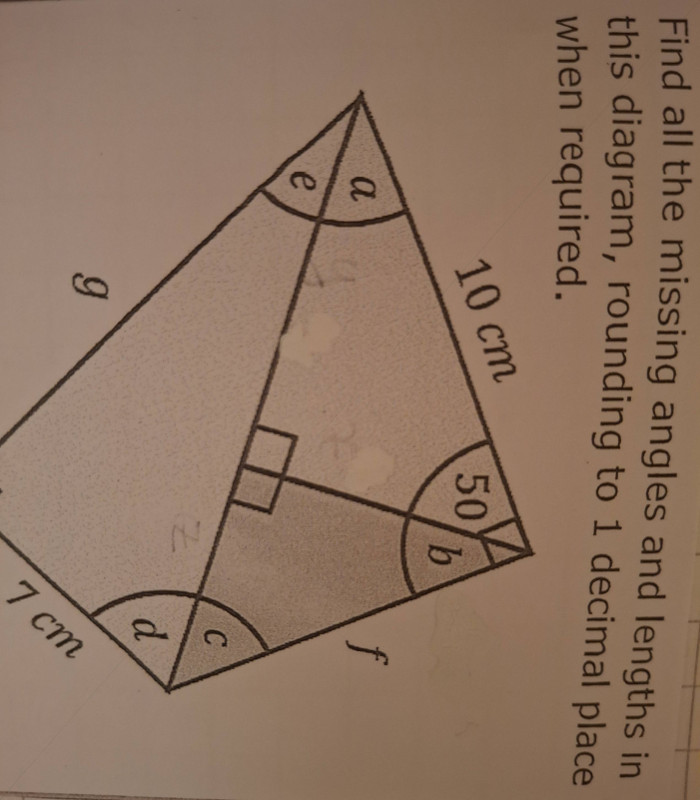
Find all the missing angles and lengths in this diagram, rounding to 1 decimal place when required. The diagram shows a quadrilateral divided into two triangles, with one triangle having sides 10 cm and 7 cm, a right angle, and a 50° angle. Missing elements are angles a, b, c, d, e and lengths f, g.
Correct Answer
a = 40.0°, b = 130.0°, c = 50.0°, d = 40.0°, e = 130.0°, f ≈ 7.7 cm, g ≈ 6.4 cm
Detailed Solution Steps
1
Step 1: Calculate angle a. In the right triangle with side 10cm, the angles sum to 180°. We know a right angle (90°) and 50°, so a = 180° - 90° - 50° = 40.0°.
2
Step 2: Calculate angle b. Angle b is supplementary to the 50° angle (they form a straight line), so b = 180° - 50° = 130.0°.
3
Step 3: Calculate length f. Use trigonometry in the right triangle: cos(50°) = adjacent/hypotenuse = f/10, so f = 10×cos(50°) ≈ 10×0.6428 ≈ 7.7 cm.
4
Step 4: Calculate length g. Use trigonometry in the right triangle: sin(50°) = opposite/hypotenuse = g/10, so g = 10×sin(50°) ≈ 10×0.7660 ≈ 6.4 cm.
5
Step 5: Identify triangle congruence. The two triangles are congruent (they share a common side, have a right angle, and sides 7cm and f≈7.7cm are corresponding, with g and the other side matching). So angle c = 50.0°, angle d = a = 40.0°, angle e = b = 130.0°.
Knowledge Points Involved
1
Angle Sum Property of Triangles
The sum of the interior angles of any triangle is 180°. This applies to all triangles, including right triangles, and is used to calculate unknown angles when two angles are known.
2
Supplementary Angles
Two angles are supplementary if they form a straight line, meaning their sum is 180°. This is used to find angles that form a linear pair with a known angle.
3
Right Triangle Trigonometry (Sine and Cosine)
In a right triangle, cos(θ) = adjacent side/hypotenuse and sin(θ) = opposite side/hypotenuse. These ratios are used to calculate unknown side lengths when an angle and the hypotenuse are known.
4
Congruent Triangles
Two triangles are congruent if their corresponding sides and angles are equal. In this diagram, the two right triangles share a common side, so their corresponding angles and matching sides are equal, allowing us to transfer known angle values to the second triangle.
Loading solution...