AI Math Solver
Resources
Questions
Pricing
Login
Register
Home
>
Questions
>
Find the Equation of the Transformed Linear Parent Function $f(x)=x$ (Reflected and Shifted Up 2 Units)
Mathematics
Grade 10 (High School)
Question Content
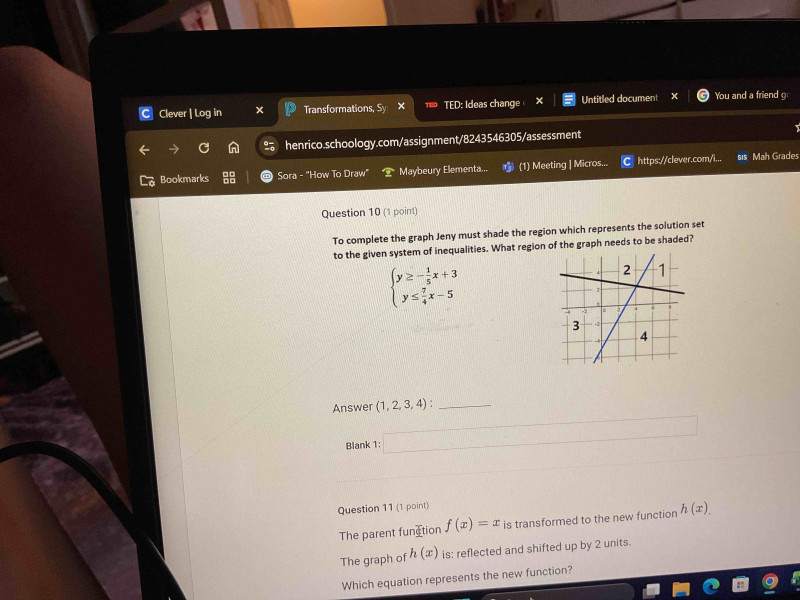
The parent function $f(x) = x$ is transformed to the new function $h(x)$. The graph of $h(x)$ is reflected and shifted up by 2 units. Which equation represents the new function?
Correct Answer
$h(x) = -x + 2$
Detailed Solution Steps
1
Step 1: Identify the parent function: $f(x) = x$.
2
Step 2: Apply the reflection transformation. A reflection over the x-axis (the standard reflection for linear parent functions) changes $f(x)$ to $-f(x)$, so $f(x) = x$ becomes $-x$.
3
Step 3: Apply the vertical shift transformation. Shifting the function up by 2 units adds 2 to the transformed function, so $-x$ becomes $-x + 2$.
4
Step 4: Combine the transformations to get the final function: $h(x) = -x + 2$.
Knowledge Points Involved
1
Vertical Reflection of Functions
A vertical reflection (over the x-axis) of a function $f(x)$ is represented by $-f(x)$. This flips the graph of the function across the x-axis, reversing the sign of all y-values.
2
Vertical Translations of Functions
A vertical shift of a function $f(x)$ up by $k$ units is represented by $f(x) + k$, where $k > 0$. A shift down would be $f(x) - k$. This transformation moves every point on the graph of $f(x)$ vertically by $k$ units.
3
Parent Functions and Transformations
Parent functions are the simplest form of a family of functions (e.g., $f(x)=x$ is the linear parent function). Transformations (reflections, shifts, stretches) modify the parent function to create new functions while preserving the core shape of the parent graph.
Loading solution...