AI Math Solver
Resources
Questions
Pricing
Login
Register
Home
>
Questions
>
Find the Exact Area of Region Bounded by Parametric Curve $x=\\sin t$, $y=\\sin2t$ and the x-axis
Mathematics
A-Level (Grade 12/13)
Question Content
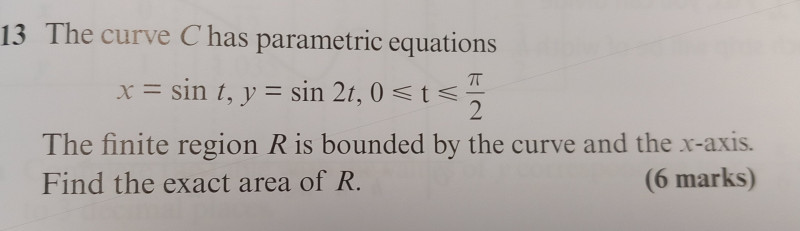
The curve C has parametric equations $x = \\sin t$, $y = \\sin 2t$, $0 \\leqslant t \\leqslant \\frac{\\pi}{2}$. The finite region R is bounded by the curve and the x-axis. Find the exact area of R. (6 marks)
Correct Answer
$\\frac{4}{3}$
Detailed Solution Steps
1
Step 1: Recall the formula for the area under a parametric curve: $A = \\int_{t_1}^{t_2} y \\frac{dx}{dt} dt$, where $t_1$ and $t_2$ are the parametric bounds corresponding to the region bounded by the curve and x-axis.
2
Step 2: Calculate $\\frac{dx}{dt}$ from $x = \\sin t$: $\\frac{dx}{dt} = \\cos t$.
3
Step 3: Substitute $y = \\sin2t$, $\\frac{dx}{dt}=\\cos t$, and the bounds $t=0$ to $t=\\frac{\\pi}{2}$ into the area formula: $A = \\int_{0}^{\\frac{\\pi}{2}} \\sin2t \\cdot \\cos t dt$.
4
Step 4: Use the double-angle identity $\\sin2t = 2\\sin t \\cos t$ to rewrite the integrand: $A = \\int_{0}^{\\frac{\\pi}{2}} 2\\sin t \\cos^2 t dt$.
5
Step 5: Use substitution to solve the integral: let $u = \\cos t$, so $\\frac{du}{dt} = -\\sin t$, meaning $-du = \\sin t dt$. Adjust the bounds: when $t=0$, $u=\\cos0=1$; when $t=\\frac{\\pi}{2}$, $u=\\cos\\frac{\\pi}{2}=0$.
6
Step 6: Rewrite the integral in terms of u: $A = 2\\int_{1}^{0} u^2 (-du) = 2\\int_{0}^{1} u^2 du$.
7
Step 7: Evaluate the definite integral: $2\\left[\\frac{u^3}{3}\\right]_{0}^{1} = 2\\left(\\frac{1^3}{3} - \\frac{0^3}{3}\\right) = 2 \\cdot \\frac{1}{3} = \\frac{4}{3}$.
Knowledge Points Involved
1
Area under a parametric curve
For a curve defined by parametric equations $x=f(t)$, $y=g(t)$, the area between the curve, x-axis, and the points corresponding to $t=a$ and $t=b$ is given by $A=\\int_{a}^{b} y \\frac{dx}{dt} dt$. This formula is derived from substituting the parametric equations into the standard Cartesian area formula $A=\\int x dy$ or $\\int y dx$ and applying the chain rule.
2
Trigonometric double-angle identities
The double-angle identity for sine states $\\sin2\\theta=2\\sin\\theta\\cos\\theta$. It is used to simplify trigonometric expressions and integrals, reducing higher-angle terms to products of single-angle trigonometric functions that are easier to integrate.
3
U-substitution for definite integrals
U-substitution is a method to solve complex integrals by substituting a part of the integrand with a new variable $u$, transforming the integral into a simpler form. When using substitution for definite integrals, the bounds of integration must be adjusted to match the new variable to avoid converting back to the original variable.
4
Power rule for integration
The power rule states that $\\int x^n dx = \\frac{x^{n+1}}{n+1} + C$ for $n \\neq -1$. For definite integrals, this rule is used to evaluate the antiderivative at the upper and lower bounds and find the difference, giving the exact value of the integral.
Loading solution...