AI Math Solver
Resources
Questions
Pricing
Login
Register
Home
>
Questions
>
Find the Inverse Variation Formula Connecting z and p (z varies inversely with p²)
Mathematics
Grade 9 (Junior High School)
Question Content
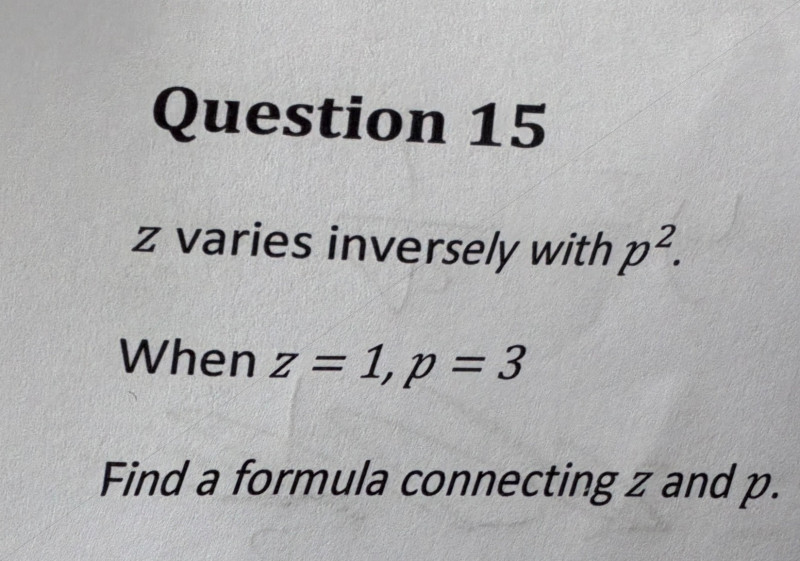
z varies inversely with $p^2$. When $z = 1$, $p = 3$. Find a formula connecting z and p.
Correct Answer
$z = \\frac{9}{p^2}$
Detailed Solution Steps
1
Step 1: Recall the general form of inverse variation. If a variable $z$ varies inversely with $p^2$, the relationship can be written as $z = \\frac{k}{p^2}$, where $k$ is the constant of proportionality that we need to find.
2
Step 2: Substitute the given values $z=1$ and $p=3$ into the general formula. This gives $1 = \\frac{k}{3^2}$.
3
Step 3: Calculate $3^2 = 9$, so the equation becomes $1 = \\frac{k}{9}$. Solve for $k$ by multiplying both sides of the equation by 9, which gives $k = 1 \\times 9 = 9$.
4
Step 4: Substitute the value of $k=9$ back into the general inverse variation formula to get the final connecting formula: $z = \\frac{9}{p^2}$.
Knowledge Points Involved
1
Inverse Variation Relationship
Inverse variation describes a relationship where one variable decreases as the other variable increases, following the form $y = \\frac{k}{x}$ (for variation between $y$ and $x$), where $k$ is a non-zero constant called the constant of proportionality. When a variable varies inversely with a power of another variable, like $p^2$, the form adjusts to $z = \\frac{k}{p^2}$. This is used to model real-world relationships such as the relationship between pressure and volume of a gas, or the intensity of light and the square of the distance from the source.
2
Constant of Proportionality
The constant of proportionality $k$ is a fixed value that defines the specific inverse (or direct) variation relationship between two variables. To find $k$, you substitute a known pair of values for the variables into the variation formula and solve for $k$. Once $k$ is found, you can write the complete formula for the relationship between the variables.
3
Algebraic Substitution and Solving for Unknowns
This is the process of replacing variables in an equation with their known numerical values, then using basic algebraic operations (like multiplication, division, addition, subtraction) to solve for the remaining unknown value. It is a fundamental skill used in all areas of algebra to find specific values or derive custom formulas from general relationships.
Loading solution...