AI Math Solver
Resources
Questions
Pricing
Login
Register
Home
>
Questions
>
Find the Leg Length of an Isosceles Right Triangle with Hypotenuse 2
Mathematics
Grade 10 of Junior High School
Question Content
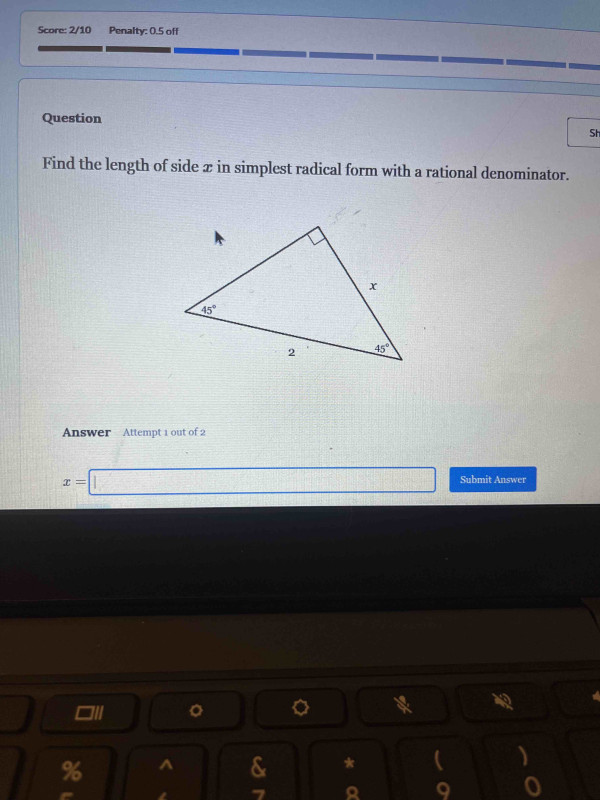
Find the length of side x in simplest radical form with a rational denominator. The figure is a right triangle with two 45-degree acute angles, hypotenuse length 2, and side x is one of the legs.
Correct Answer
√2
Detailed Solution Steps
1
Step 1: Identify the type of triangle. Since the triangle has one right angle and two equal 45° acute angles, it is an isosceles right triangle, meaning the two legs are congruent.
2
Step 2: Apply the Pythagorean theorem. For a right triangle, \(a^2 + b^2 = c^2\), where \(c\) is the hypotenuse, and \(a\) and \(b\) are the legs. Here, \(a = x\), \(b = x\), and \(c = 2\).
3
Step 3: Substitute the values into the theorem: \(x^2 + x^2 = 2^2\).
4
Step 4: Simplify the equation: \(2x^2 = 4\). Divide both sides by 2: \(x^2 = 2\).
5
Step 5: Solve for x by taking the square root of both sides: \(x = \sqrt{2}\). This is already in simplest radical form with a rational denominator.
Knowledge Points Involved
1
Isosceles Right Triangle Properties
An isosceles right triangle has one 90° right angle and two 45° acute angles. The two legs opposite the 45° angles are equal in length, and the hypotenuse is √2 times the length of either leg. This property is used to quickly relate side lengths without full use of the Pythagorean theorem.
2
Pythagorean Theorem
The theorem states that in any right-angled triangle, the square of the length of the hypotenuse (the side opposite the right angle) is equal to the sum of the squares of the lengths of the other two legs. The formula is \(a^2 + b^2 = c^2\), where \(c\) is the hypotenuse, and \(a\) and \(b\) are the legs. It is used to find unknown side lengths in right triangles.
3
Simplest Radical Form with Rational Denominator
A radical expression is in simplest form when there are no perfect square factors under the radical, no fractions under the radical, and no radicals in the denominator. For expressions like \(\\frac{1}{\\sqrt{2}}\), we rationalize the denominator by multiplying numerator and denominator by \(\\sqrt{2}\) to get \(\\frac{\\sqrt{2}}{2}\). In this problem, \(\\sqrt{2}\) already meets the requirements.
Loading solution...