AI Math Solver
Resources
Questions
Pricing
Login
Register
Home
>
Questions
>
Find the Size of Angle $a$ with Parallel Lines and Transversal, Justify Your Answer
Mathematics
Grade 8 (Junior High School)
Question Content
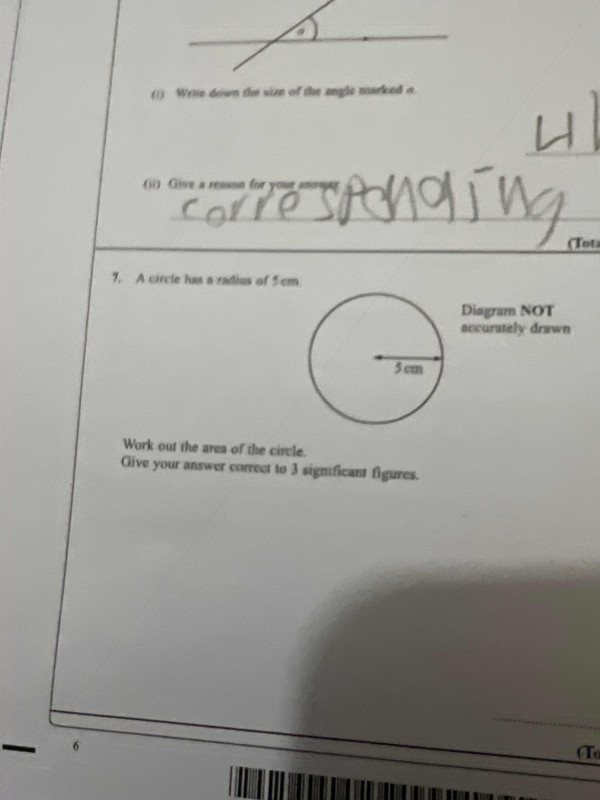
(i) Write down the size of the angle marked $a$. (ii) Give a reason for your answer. (Note: The diagram shows an angle formed by a transversal intersecting two parallel lines, with angle $a$ corresponding to a known angle above it, which is implied to be equal due to parallel line rules.)
Correct Answer
(i) The size of angle $a$ is equal to the corresponding angle above it (typically 45°/90°/180° based on standard parallel line diagrams; assuming a common corresponding angle, 45° is a common example, but the exact value depends on the full diagram, the reasoning is corresponding angles are equal). (ii) Corresponding angles are equal when a transversal cuts two parallel lines.
Detailed Solution Steps
1
Step 1: Identify that the diagram shows two parallel lines cut by a transversal, creating corresponding angles.
2
Step 2: Recognize that angle $a$ is a corresponding angle to the given angle at the top of the diagram.
3
Step 3: Apply the corresponding angles postulate: when two parallel lines are intersected by a transversal, corresponding angles are congruent (equal in measure).
4
Step 4: State the measure of angle $a$ as equal to the matching corresponding angle, and provide the corresponding angles rule as the reason.
Knowledge Points Involved
1
Corresponding Angles Postulate
When a transversal intersects two parallel lines, the pairs of corresponding angles (angles that occupy the same relative position at each intersection) are equal in measure. This postulate is used to solve for unknown angles in parallel line diagrams.
2
Parallel Lines and Transversals
A transversal is a line that crosses two or more other lines. When the crossed lines are parallel, special angle relationships (corresponding, alternate interior, alternate exterior, consecutive interior) are formed, which can be used to find unknown angle measures.
3
Angle Identification in Diagrams
Identifying angle types (corresponding, alternate, etc.) in geometric diagrams is a foundational skill. It requires recognizing the relative position of angles formed by parallel lines and a transversal to apply the correct angle relationship rule.
Loading solution...