AI Math Solver
Resources
Questions
Pricing
Login
Register
Home
>
Questions
>
Find Unknown Hypotenuse x in Right-Angled Triangle with Legs 0.7 cm and 2.1 cm
Mathematics
Grade 8 (Junior High School)
Question Content
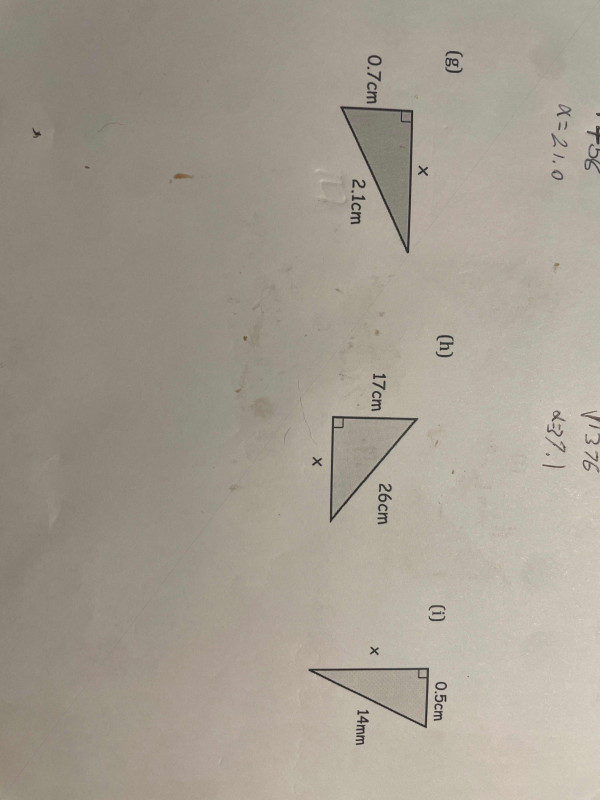
Find the length of the unknown side x in the right-angled triangle (g) with legs 0.7 cm and 2.1 cm.
Correct Answer
≈2.21 cm or (7√10)/10 cm
Detailed Solution Steps
1
Step 1: Identify that this is a right-angled triangle, so the Pythagorean theorem applies. The theorem states that for a right-angled triangle with legs a, b and hypotenuse c, a² + b² = c².
2
Step 2: Label the known sides: a = 0.7 cm, b = 2.1 cm, and x is the hypotenuse c.
3
Step 3: Substitute the values into the formula: (0.7)² + (2.1)² = x².
4
Step 4: Calculate the squares: 0.49 + 4.41 = x², so x² = 4.9.
5
Step 5: Solve for x by taking the square root: x = √4.9 ≈ 2.21 cm, or in exact form, √(49/10) = (7√10)/10 cm.
Knowledge Points Involved
1
Pythagorean Theorem
A fundamental theorem for right-angled triangles, stating that the sum of the squares of the lengths of the two legs (the sides forming the right angle) equals the square of the length of the hypotenuse (the side opposite the right angle). It is used to find unknown side lengths in right-angled triangles, verify if a triangle is right-angled, and solve real-world distance problems.
2
Square Roots of Decimals
The process of finding a number that, when multiplied by itself, equals a given decimal value. It is used to solve for unknown sides in geometric problems involving squared terms, and can be calculated using a calculator for approximate values or simplified to exact radical form for precision.
Loading solution...