AI Math Solver
Resources
Questions
Pricing
Login
Register
Home
>
Questions
>
How to Calculate the Area of an L-shaped Composite Geometric Figure
Mathematics
Grade 5 of Primary School
Question Content
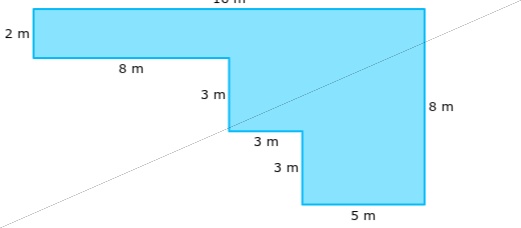
Calculate the area of the blue L-shaped figure with the given side lengths: top horizontal side 10m, left vertical side 2m, horizontal segment 8m, vertical segment 3m, inner horizontal segment 3m, inner vertical segment 3m, bottom right horizontal side 5m, right vertical side 8m.
Correct Answer
61 m²
Detailed Solution Steps
1
Step 1: Divide the L-shaped figure into three rectangles. The first rectangle is the top-left one with dimensions 10m × 2m. The second is the middle vertical rectangle with dimensions (8-2-3)m × (10-8)m = 3m × 2m. The third is the bottom-right rectangle with dimensions 5m × (8-3)m = 5m × 5m.
2
Step 2: Calculate the area of each rectangle. Area of first rectangle: 10×2 = 20 m². Area of second rectangle: 3×2 = 6 m². Area of third rectangle: 5×5 = 25 m².
3
Step 3: Add the areas of the three rectangles together: 20 + 6 + 25 = 61 m². Alternatively, calculate the area of the large 10m×8m rectangle and subtract the area of the inner missing rectangle (8-5)m×(8-2)m=3m×6m: (10×8) - (3×6) = 80 - 19 = 61 m².
Knowledge Points Involved
1
Area of Rectangles
The area of a rectangle is calculated by multiplying its length by its width, expressed as the formula A = l×w. This is a basic geometric formula used to find the space enclosed by a four-sided figure with four right angles, and it is the foundation for calculating areas of composite shapes.
2
Area of Composite Shapes
Composite shapes are irregular shapes made up of multiple basic geometric figures. Their area can be found by either dividing the shape into smaller basic shapes (like rectangles, squares) and summing their areas, or by finding the area of a larger enclosing shape and subtracting the area of the missing parts. This method is used to solve area problems for non-standard geometric figures.
3
Dimensional Analysis for Composite Shapes
When working with composite shapes, it is necessary to derive the unknown side lengths using the given known dimensions. For example, finding the height of a middle rectangle by subtracting the known vertical lengths from the total height of the shape. This requires understanding the relationships between the sides of connected geometric figures.
Loading solution...