AI Math Solver
Resources
Questions
Pricing
Login
Register
Home
>
Questions
>
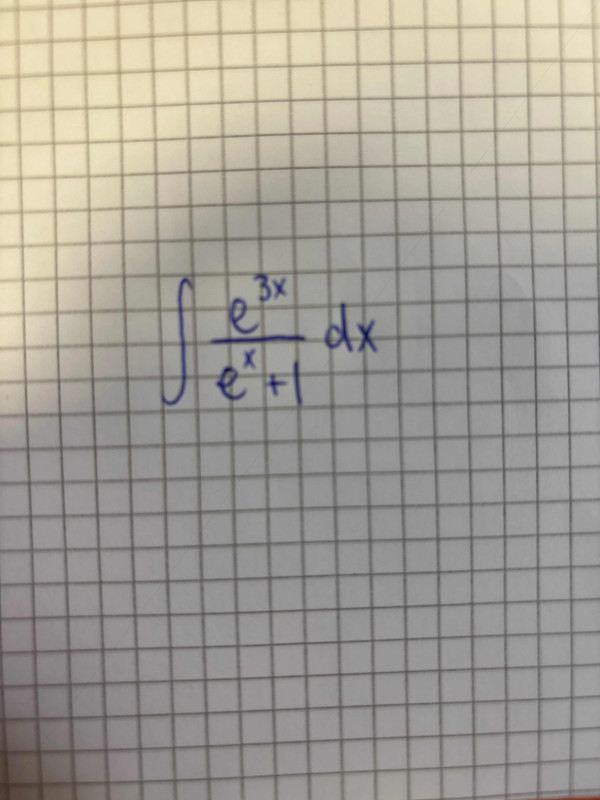
How to Calculate the Indefinite Integral of $\frac{e^{3x}}{e^{x}+1}$
Mathematics
Grade 11 of Senior High School
Question Content
Calculate the indefinite integral: $\int \frac{e^{3x}}{e^{x}+1} dx$
Correct Answer
$\frac{1}{2}e^{2x}-e^{x}+\ln|e^{x}+1|+C$
Detailed Solution Steps
1
Step 1: Simplify the integrand using algebraic transformation. First, rewrite the numerator $e^{3x}$ as $e^{3x}+e^{2x}-e^{2x}-e^{x}+e^{x}$, so the integrand becomes $\frac{e^{3x}+e^{2x}-e^{2x}-e^{x}+e^{x}}{e^{x}+1} = \frac{e^{2x}(e^{x}+1)-e^{x}(e^{x}+1)+e^{x}}{e^{x}+1}$.
2
Step 2: Split the fraction into three parts: $e^{2x}-e^{x}+\frac{e^{x}}{e^{x}+1}$. Now the integral is transformed into $\int (e^{2x}-e^{x}+\frac{e^{x}}{e^{x}+1}) dx$.
3
Step 3: Calculate the integral term by term. For $\int e^{2x}dx$, use the integral rule $\int e^{ax}dx=\frac{1}{a}e^{ax}+C$, so it equals $\frac{1}{2}e^{2x}$; for $\int e^{x}dx$, it equals $e^{x}$; for $\int \frac{e^{x}}{e^{x}+1}dx$, use substitution method: let $u=e^{x}+1$, then $du=e^{x}dx$, so the integral becomes $\int \frac{1}{u}du=\ln|u|+C=\ln|e^{x}+1|+C$.
4
Step 4: Combine all the results and add the constant of integration $C$, getting the final result: $\frac{1}{2}e^{2x}-e^{x}+\ln|e^{x}+1|+C$.
Knowledge Points Involved
1
Indefinite Integral of Exponential Functions
The integral rule for exponential functions is $\int e^{ax}dx=\frac{1}{a}e^{ax}+C$ ($a\\neq0$, $C$ is the constant of integration). It is used to calculate integrals of basic exponential terms, which is a fundamental rule in integral calculus for handling exponential integrands.
2
Substitution Method for Indefinite Integrals
Also called u-substitution, it is a method to transform a complex integral into a simpler one by substituting a new variable for a part of the integrand. For integrals in the form $\int f(g(x))g'(x)dx$, let $u=g(x)$, then $du=g'(x)dx$, and the integral becomes $\int f(u)du$. It is widely used for integrals with composite functions, like $\int \frac{e^{x}}{e^{x}+1}dx$ in this problem.
3
Algebraic Transformation of Integrands
When the integrand is a rational function of exponential functions, we can use algebraic operations (such as adding and subtracting terms) to decompose the complex fraction into a sum of simpler terms that are easier to integrate. This skill is essential for handling non-standard integrands that cannot be directly integrated with basic rules.
Loading solution...