AI Math Solver
Resources
Questions
Pricing
Login
Register
Home
>
Questions
>
How to Calculate the Probability of a Total of 10 When Spinning Two Fair Spinners
Mathematics
Grade 8 (Junior High School)
Question Content
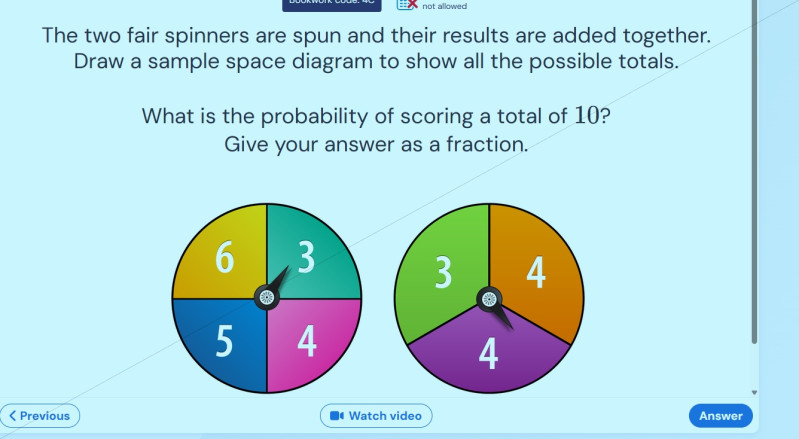
The two fair spinners are spun and their results are added together. Draw a sample space diagram to show all the possible totals. What is the probability of scoring a total of 10? Give your answer as a fraction. (Spinner 1 has sections: 6, 3, 4, 5; Spinner 2 has sections: 3, 4, 4)
Correct Answer
1/6
Detailed Solution Steps
1
Step 1: List all possible outcomes of spinning both spinners. Spinner 1 has 4 possible values: 3, 4, 5, 6. Spinner 2 has 3 possible values: 3, 4, 4. The total number of combined outcomes is 4 × 3 = 12.
2
Step 2: Calculate the sum of each pair of outcomes: (3+3)=6, (3+4)=7, (3+4)=7, (4+3)=7, (4+4)=8, (4+4)=8, (5+3)=8, (5+4)=9, (5+4)=9, (6+3)=9, (6+4)=10, (6+4)=10.
3
Step 3: Count the number of outcomes that result in a total of 10. From the sums above, there are 2 such outcomes: (6,4) and (6,4).
4
Step 4: Calculate probability using the formula: Probability = (Number of favorable outcomes) / (Total number of possible outcomes). So probability = 2/12, which simplifies to 1/6.
Knowledge Points Involved
1
Sample Space
The sample space is the set of all possible outcomes of a probability experiment. For combined events like spinning two spinners, it includes every possible pair of results, calculated by multiplying the number of outcomes for each individual event. It is used to systematically list all possible results to avoid missing or double-counting outcomes.
2
Probability Calculation for Fair Events
For fair, independent events, the probability of a favorable outcome is the ratio of the number of favorable outcomes to the total number of equally likely possible outcomes. The formula is P(event) = (Number of favorable outcomes) / (Total number of possible outcomes). This only applies when all outcomes have the same chance of occurring.
3
Simplifying Fractions
Simplifying a fraction means dividing both the numerator and denominator by their greatest common divisor (GCD) to get an equivalent fraction in its lowest terms. For example, 2/12 simplifies to 1/6 because the GCD of 2 and 12 is 2, and dividing both by 2 gives the simplified form.
4
Combined Independent Events
Independent events are events where the outcome of one does not affect the outcome of the other. When calculating outcomes for combined independent events, the total number of possible outcomes is the product of the number of outcomes for each individual event. Spinning two separate spinners is an example of independent events.
Loading solution...