AI Math Solver
Resources
Questions
Pricing
Login
Register
Home
>
Questions
>
Match Linear Inequalities to Number Line Graph (x ≤ -4) | 8th Grade Math
Mathematics
Grade 8 (Junior High School)
Question Content
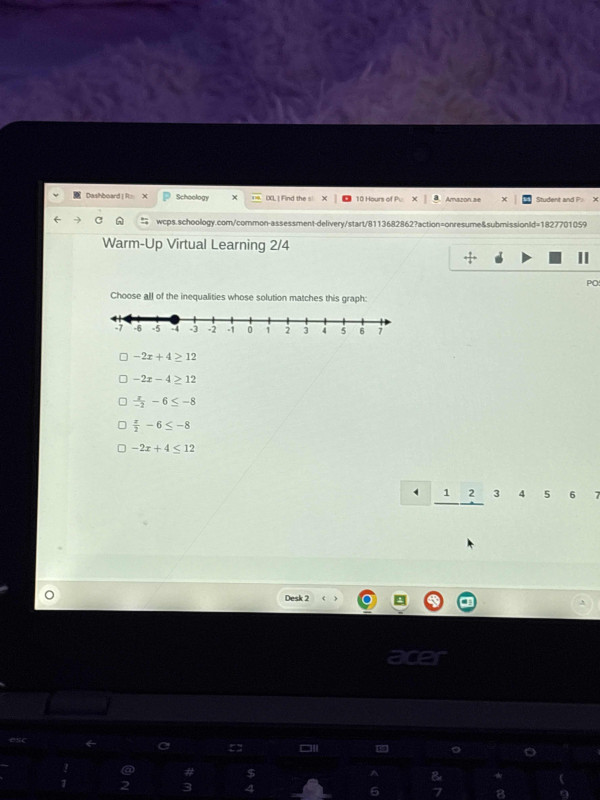
Choose all of the inequalities whose solution matches this graph: [A number line graph with a closed dot at -4 and shading to the left, representing all real numbers less than or equal to -4]
Correct Answer
-2x + 4 ≥ 12, -x/2 -6 ≤ -8
Detailed Solution Steps
1
Step 1: First, identify the solution from the graph. The closed dot at -4 and left shading means the solution is x ≤ -4.
2
Step 2: Solve each inequality one by one:
3
- For -2x + 4 ≥ 12: Subtract 4 from both sides to get -2x ≥ 8. Divide both sides by -2 (remember to reverse the inequality sign when dividing by a negative number) to get x ≤ -4. This matches the graph.
4
- For -2x - 4 ≥ 12: Add 4 to both sides to get -2x ≥ 16. Divide by -2 and reverse the sign to get x ≤ -8. This does not match the graph.
5
- For -x/2 -6 ≤ -8: Add 6 to both sides to get -x/2 ≤ -2. Multiply both sides by -2 (reverse the inequality sign) to get x ≥ 4. This does not match the graph.
6
- For x/2 -6 ≤ -8: Add 6 to both sides to get x/2 ≤ -2. Multiply both sides by 2 to get x ≤ -4. This matches the graph.
7
- For -2x + 4 ≤ 12: Subtract 4 from both sides to get -2x ≤ 8. Divide by -2 and reverse the sign to get x ≥ -4. This does not match the graph.
8
Step 3: Select the inequalities that have the solution x ≤ -4, which are -2x + 4 ≥ 12 and x/2 -6 ≤ -8.
Knowledge Points Involved
1
Number Line Graphs for Inequalities
A closed dot on a number line indicates that the value is included in the solution set (used with ≤ or ≥), while an open dot means the value is not included (used with < or >). Shading to the left represents values less than the marked point, and shading to the right represents values greater than the marked point.
2
Solving Linear Inequalities with One Variable
Linear inequalities are solved using inverse operations, similar to linear equations. The key rule is that when multiplying or dividing both sides of an inequality by a negative number, the direction of the inequality sign must be reversed to maintain the truth of the statement.
3
Inverse Operations for Inequalities
Inverse operations are used to isolate the variable: addition and subtraction are inverses, multiplication and division are inverses. When applying these to inequalities, the balance of the inequality must be preserved, with the special rule for negative multipliers/divisors.
Loading solution...