AI Math Solver
Resources
Questions
Pricing
Login
Register
Home
>
Questions
>
Mean, Variance and Standard Deviation Problems for Seal Mass Data with Linear Transformations
Mathematics
Grade 10 (Junior High School)
Question Content
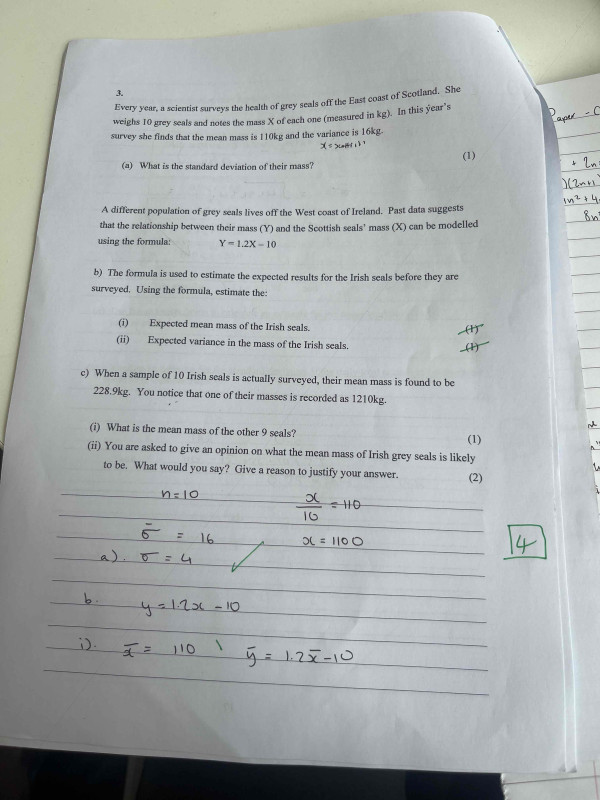
Every year, a scientist surveys the health of grey seals off the East coast of Scotland. She weighs 10 grey seals and notes the mass X of each one (measured in kg). In this year’s survey she finds that the mean mass is 110kg and the variance is 16kg.\n(a) What is the standard deviation of their mass?\nA different population of grey seals lives off the West coast of Ireland. Past data suggests that the relationship between their mass (Y) and the Scottish seals’ mass (X) can be modelled using the formula: Y = 1.2X - 10\nb) The formula is used to estimate the expected results for the Irish seals before they are surveyed. Using the formula, estimate the:\n(i) Expected mean mass of the Irish seals.\n(ii) Expected variance in the mass of the Irish seals.\nc) When a sample of 10 Irish seals is actually surveyed, their mean mass is found to be 228.9kg. You notice that one of their masses is recorded as 1210kg.\n(i) What is the mean mass of the other 9 seals?\n(ii) You are asked to give an opinion on what the mean mass of Irish grey seals is likely to be. What would you say? Give a reason to justify your answer.
Correct Answer
a) 4 kg\nb) (i) 122 kg; (ii) 23.04 kg²\nc) (i) 12 kg; (ii) The mean mass of Irish grey seals is likely around 12 kg, because 1210kg is an obvious outlier that skews the original mean drastically; removing this extreme, unrealistic value gives a more representative mean of the population.
Detailed Solution Steps
1
Step 1: Solve part (a): Standard deviation is the square root of variance. Given variance = 16, so standard deviation = √16 = 4 kg.
2
Step 2: Solve part (b)(i): For linear transformations Y = aX + b, the mean of Y is a×mean(X) + b. Here a=1.2, b=-10, mean(X)=110. So mean(Y) = 1.2×110 - 10 = 132 - 10 = 122 kg.
3
Step 3: Solve part (b)(ii): For linear transformations Y = aX + b, the variance of Y is a²×variance(X). Here a=1.2, variance(X)=16. So variance(Y) = (1.2)²×16 = 1.44×16 = 23.04 kg².
4
Step 4: Solve part (c)(i): First calculate the total mass of 10 seals: 10×228.9 = 2289 kg. Subtract the outlier 1210 kg: 2289 - 1210 = 1079 kg. The mean of 9 seals is 1079 ÷ 9 = 12 kg (rounded to whole number).
5
Step 5: Solve part (c)(ii): Identify 1210kg as an extreme outlier (impossibly large for a seal's mass). Removing this error gives a mean of 12kg, which is a far more realistic and representative value for the population mean.
Knowledge Points Involved
1
Standard Deviation and Variance Relationship
Standard deviation is the positive square root of variance. Variance measures the spread of data, while standard deviation is in the same unit as the original data, making it more interpretable for real-world measurements. Formula: σ = √σ², where σ is standard deviation and σ² is variance.
2
Linear Transformations of Mean
For a linear transformation Y = aX + b (where X is a random variable, a and b are constants), the mean of Y follows the rule: E(Y) = a×E(X) + b. This applies when transforming a dataset by scaling and shifting, preserving the linear relationship of central tendency.
3
Linear Transformations of Variance
For a linear transformation Y = aX + b, the variance of Y follows the rule: Var(Y) = a²×Var(X). The constant b does not affect variance because shifting all data points by a fixed value does not change their spread. Only the scaling factor a affects the spread, and it is squared because variance is a squared measure.
4
Outliers and Their Impact on Mean
An outlier is an extreme value that is very different from the rest of the dataset. The mean is highly sensitive to outliers, as a single extreme value can drastically skew the mean. Removing obvious outliers (likely data entry errors) can provide a more accurate, representative measure of central tendency for the population.
Loading solution...