AI Math Solver
Resources
Questions
Pricing
Login
Register
Home
>
Questions
>
Primary 6 Math Problem: Find Used Thread Length with Ratio and Unit Conversion
Mathematics
Grade 6 of Primary School
Question Content
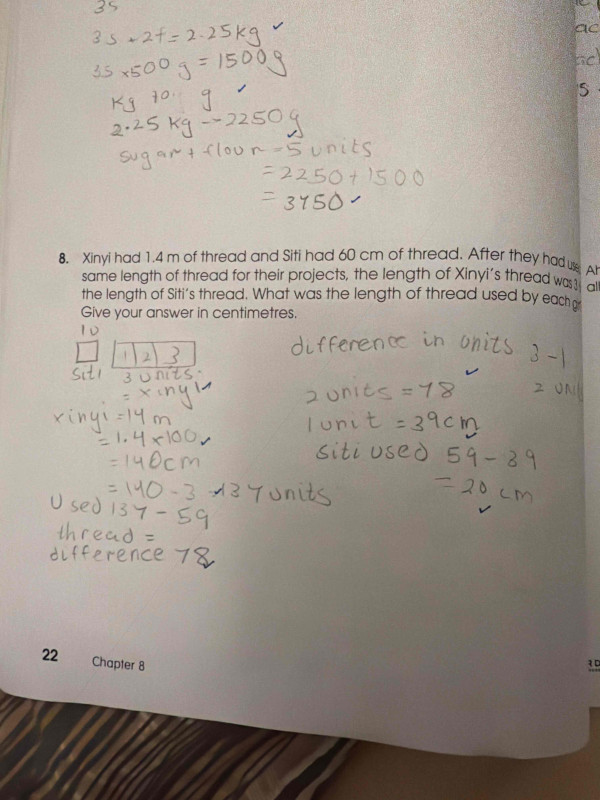
Xinyi had 1.4 m of thread and Siti had 60 cm of thread. After they had used the same length of thread for their projects, the length of Xinyi's thread was 3 times the length of Siti's thread. What was the length of thread used by each girl? Give your answer in centimetres.
Correct Answer
20 cm
Detailed Solution Steps
1
Step 1: Convert Xinyi's thread length to centimetres to keep units consistent. Since 1 m = 100 cm, 1.4 m = 1.4 × 100 = 140 cm.
2
Step 2: Let the length of thread used by each girl be \( x \) cm. After using the thread, Xinyi's remaining thread is \( 140 - x \) cm, and Siti's remaining thread is \( 60 - x \) cm.
3
Step 3: Set up the equation based on the given relationship: \( 140 - x = 3(60 - x) \).
4
Step 4: Expand and solve the equation: \( 140 - x = 180 - 3x \). Add \( 3x \) to both sides: \( 140 + 2x = 180 \). Subtract 140 from both sides: \( 2x = 40 \). Divide both sides by 2: \( x = 20 \).
5
Alternative step (using unit difference method): Calculate the original length difference: 140 - 60 = 80 cm. The ratio of remaining threads is 3:1, so the difference in units is 3 - 1 = 2 units. 2 units = 80 cm, so 1 unit = 40 cm. Siti's remaining thread is 40 cm, so the used length is 60 - 40 = 20 cm.
Knowledge Points Involved
1
Unit Conversion
This refers to converting measurements between different units of the same quantity. For length, 1 metre = 100 centimetres. It is used to ensure all values in a problem use the same unit for accurate calculations.
2
Linear Equations with One Variable
An equation that contains only one unknown variable with a power of 1. It is used to represent real-world relationships and solve for an unknown value by isolating the variable through inverse operations.
3
Ratio and Difference Relationships
When two quantities have a given ratio after a change, their original fixed difference can be used to find the value of one 'unit' in the ratio, then calculate the unknown value. This is useful for problems where the same amount is added or subtracted from both quantities.
Loading solution...