AI Math Solver
Resources
Questions
Pricing
Login
Register
Home
>
Questions
>
Solve Conditional and Combined Probability Problems with Given P(A), P(B), P(A∩B)
Mathematics (Probability)
Grade 11 (Senior High School)
Question Content
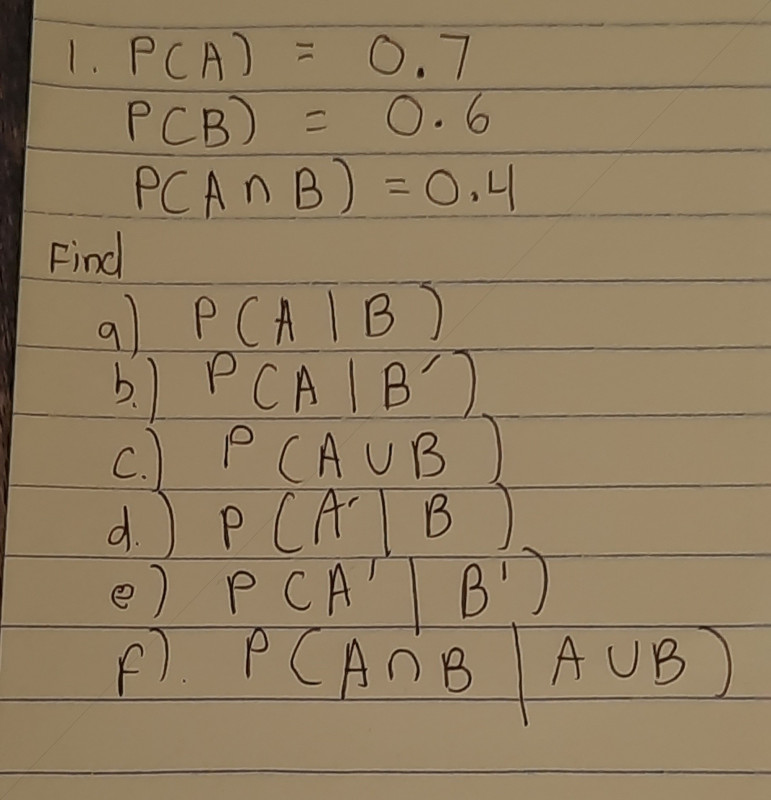
Given P(A) = 0.7, P(B) = 0.6, P(A∩B) = 0.4. Find: a) P(A|B), b) P(A|B'), c) P(A∪B), d) P(A'|B), e) P(A'|B'), f) P(A∩B | A∪B)
Correct Answer
a) 2/3 ≈ 0.6667; b) 0.5; c) 0.9; d) 1/3 ≈ 0.3333; e) 1/4 = 0.25; f) 4/9 ≈ 0.4444
Detailed Solution Steps
1
Step 1: Recall core probability formulas: Conditional Probability P(X|Y) = P(X∩Y)/P(Y); Complement Rule P(X') = 1 - P(X); Addition Rule P(X∪Y) = P(X) + P(Y) - P(X∩Y)
2
Step 2: Calculate part a) P(A|B): Use conditional probability formula: P(A|B) = P(A∩B)/P(B) = 0.4/0.6 = 2/3 ≈ 0.6667
3
Step 3: Calculate part b) P(A|B'): First find P(B') = 1 - P(B) = 1 - 0.6 = 0.4. Then find P(A∩B') = P(A) - P(A∩B) = 0.7 - 0.4 = 0.3. Apply conditional probability: P(A|B') = P(A∩B')/P(B') = 0.3/0.6 = 0.5
4
Step 4: Calculate part c) P(A∪B): Use addition rule: P(A∪B) = P(A) + P(B) - P(A∩B) = 0.7 + 0.6 - 0.4 = 0.9
5
Step 5: Calculate part d) P(A'|B): First find P(A'∩B) = P(B) - P(A∩B) = 0.6 - 0.4 = 0.2. Apply conditional probability: P(A'|B) = P(A'∩B)/P(B) = 0.2/0.6 = 1/3 ≈ 0.3333
6
Step 6: Calculate part e) P(A'|B'): First find P(A'∩B') = 1 - P(A∪B) = 1 - 0.9 = 0.1. Find P(B') = 0.4. Apply conditional probability: P(A'|B') = P(A'∩B')/P(B') = 0.1/0.4 = 1/4 = 0.25
7
Step 7: Calculate part f) P(A∩B | A∪B): Use conditional probability formula: P(A∩B | A∪B) = P((A∩B)∩(A∪B))/P(A∪B) = P(A∩B)/P(A∪B) = 0.4/0.9 = 4/9 ≈ 0.4444
Knowledge Points Involved
1
Conditional Probability
The probability of an event X occurring given that event Y has already occurred, defined as P(X|Y) = P(X∩Y)/P(Y) where P(Y) > 0. Used to calculate probabilities dependent on the occurrence of another event.
2
Addition Rule for Probabilities
Calculates the probability of either event X or event Y occurring, given by P(X∪Y) = P(X) + P(Y) - P(X∩Y). The subtraction of P(X∩Y) avoids double-counting the overlap of the two events.
3
Complement Rule
The probability of the complement of an event X (the event that X does not occur) is P(X') = 1 - P(X). Used to find probabilities of non-occurrence of an event.
4
Probability of Intersection for Complementary Events
For events X and Y, P(X∩Y') = P(X) - P(X∩Y), which represents the probability that X occurs but Y does not. Derived from the fact that X can be split into mutually exclusive parts: X∩Y and X∩Y'.
Loading solution...