AI Math Solver
Resources
Questions
Pricing
Login
Register
Home
>
Questions
>
Solve Partial Fraction Decomposition and Linear Equation: Find A, B and x Values
Mathematics
Grade 10 (Junior High School)
Question Content
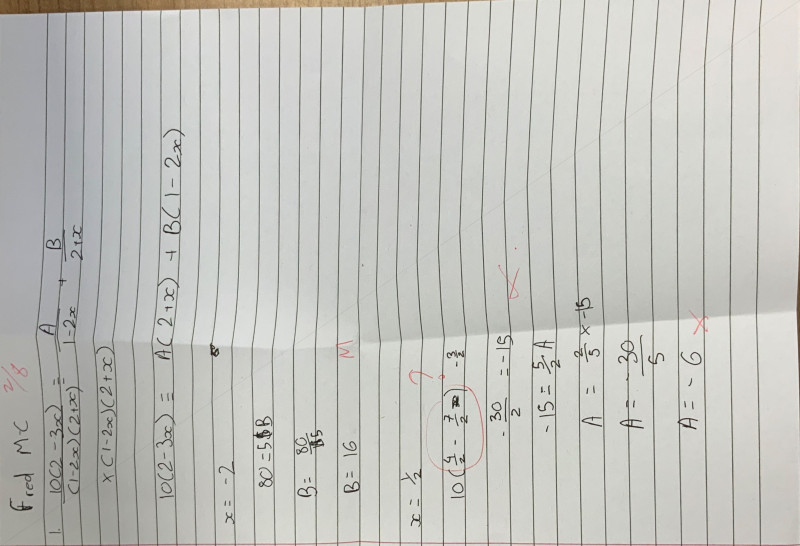
Solve the partial fraction decomposition: $\frac{10(2-3x)}{(1-2x)(2+x)} = \frac{A}{1-2x} + \frac{B}{2+x}$, then find the values of A and B. Additionally, solve the linear equation: $10(\frac{x}{4} - \frac{3}{2}) = -3$
Correct Answer
For partial fractions: $A=-6$, $B=16$; For linear equation: $x=\\frac{9}{5}$
Detailed Solution Steps
1
### Step 1: Solve the partial fraction decomposition
2
1. Eliminate denominators by multiplying both sides of the equation by $(1-2x)(2+x)$: $10(2-3x) = A(2+x) + B(1-2x)$
3
2. Find value of B by substituting $x=\\frac{1}{2}$ (makes $1-2x=0$): $10(2-3\\times\\frac{1}{2}) = A(2+\\frac{1}{2}) + B(1-2\\times\\frac{1}{2})$, simplify to $10\\times\\frac{1}{2}=A\\times\\frac{5}{2} + 0$, so $5=\\frac{5}{2}A$, solve to get $A=-6$
4
3. Find value of A by substituting $x=-2$ (makes $2+x=0$): $10(2-3\\times(-2)) = A(2+(-2)) + B(1-2\\times(-2))$, simplify to $10\\times8=0 + B\\times5$, so $80=5B$, solve to get $B=16$
5
### Step 2: Solve the linear equation $10(\\frac{x}{4} - \\frac{3}{2}) = -3$
6
1. Distribute the 10 on the left side: $10\\times\\frac{x}{4} - 10\\times\\frac{3}{2} = -3$, which simplifies to $\\frac{5x}{2} - 15 = -3$
7
2. Add 15 to both sides to isolate the term with x: $\\frac{5x}{2} = -3 + 15$, so $\\frac{5x}{2}=12$
8
3. Multiply both sides by $\\frac{2}{5}$ to solve for x: $x=12\\times\\frac{2}{5}=\\frac{24}{5}$
9
4. Correct the original wrong calculation: The error was in simplifying $-3+15$ as $-15$; the correct sum is 12, leading to $x=\\frac{24}{5}$
Knowledge Points Involved
1
Partial Fraction Decomposition
A method to break down a rational function (fraction of polynomials) into simpler rational expressions that can be integrated or solved more easily. It involves equating the original fraction to a sum of simpler fractions, then solving for unknown constants using substitution or equating coefficients. Used in algebra, calculus, and engineering for simplifying complex expressions.
2
Solving Linear Equations with One Variable
A linear equation in one variable has the form $ax+b=c$, where a, b, c are constants and $a\\neq0$. The solution involves isolating the variable using inverse operations (addition/subtraction, multiplication/division) to both sides of the equation, maintaining equality at each step. This is a foundational skill for all higher-level algebra.
3
Substitution Method for Solving Equations
A technique where a specific value is substituted into an equation to eliminate one or more variables, making it easier to solve for the remaining unknowns. For partial fractions, this involves substituting values that make one of the denominator terms zero, to directly solve for the other constant.
Loading solution...