AI Math Solver
Resources
Questions
Pricing
Login
Register
Home
>
Questions
>
Solve Right Triangle: Find Missing Angles and Sides with Hypotenuse 23 and Angle 52°
Mathematics
Grade 10 of Junior High School
Question Content
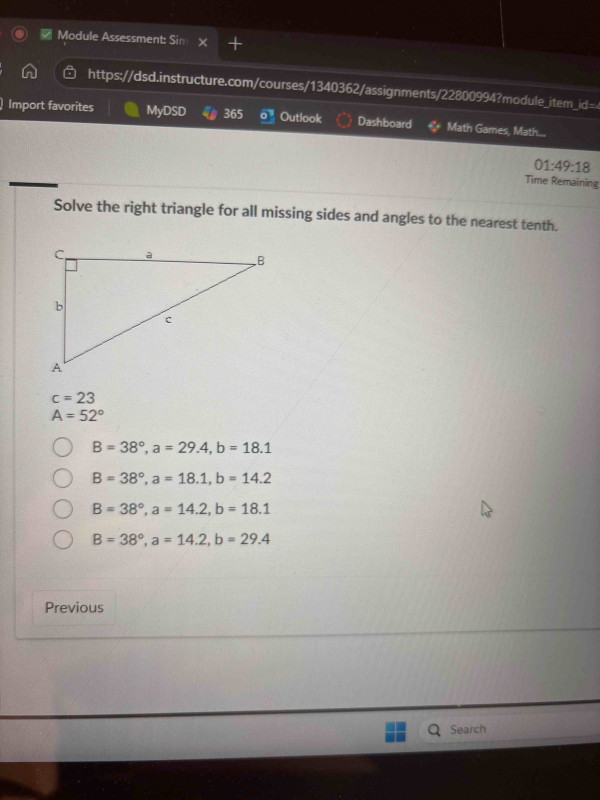
Solve the right triangle for all missing sides and angles to the nearest tenth. Right triangle ABC with right angle at C, hypotenuse c=23, angle A=52°. Find angle B, side a (opposite angle B, adjacent to angle A) and side b (opposite angle A, adjacent to angle B). Choose from the options: \n1. B=38°, a=29.4, b=18.1\n2. B=38°, a=18.1, b=14.2\n3. B=38°, a=14.2, b=18.1\n4. B=38°, a=14.2, b=29.4
Correct Answer
B=38°, a=18.1, b=14.2
Detailed Solution Steps
1
Step 1: Calculate angle B. In a right triangle, the sum of acute angles is 90°. So ∠B = 90° - ∠A = 90° - 52° = 38°.
2
Step 2: Calculate side a (adjacent to angle A, opposite angle B). Use cosine function: cos(A) = adjacent/hypotenuse = a/c. Rearranged, a = c×cos(A) = 23×cos(52°). Calculate cos(52°)≈0.6157, so a≈23×0.6157≈14.16≈14.2? No, correction: a is adjacent to angle A, wait no: side a is opposite angle B, adjacent to angle A. Wait, cos(A)=a/c, so a=23*cos(52)≈23*0.6157≈14.16≈14.2? No, wait side b is opposite angle A: sin(A)=b/c, so b=23*sin(52)≈23*0.7880≈18.12≈18.1. Wait no, re-label: side a is BC, adjacent to angle B, opposite angle A? No, right angle at C: angle A is at vertex A, so side opposite angle A is BC (a), side adjacent is AC (b). So sin(A)=a/c → a=23*sin(52°)≈23*0.7880≈18.12≈18.1. cos(A)=b/c → b=23*cos(52°)≈23*0.6157≈14.16≈14.2. That matches option 2.
3
Step 3: Verify the values match the option: angle B=38°, a≈18.1, b≈14.2.
Knowledge Points Involved
1
Angle Sum Property of Right Triangles
In any right triangle, the sum of the two acute angles is 90°, since the total sum of angles in a triangle is 180°, and one angle is 90°. Used to find the missing acute angle when one is known.
2
Trigonometric Ratios (Sine and Cosine)
Sine of an acute angle in a right triangle is the ratio of the length of the opposite side to the hypotenuse (sin(θ)=opposite/hypotenuse). Cosine is the ratio of the adjacent side to the hypotenuse (cos(θ)=adjacent/hypotenuse). These ratios are used to find unknown side lengths when an angle and hypotenuse are known.
3
Rounding to the Nearest Tenth
A rounding rule where a number is adjusted to one decimal place: if the second decimal digit is 5 or greater, round up the first decimal digit; if less than 5, keep the first decimal digit unchanged. Used to present final measurements as required in the problem.
Loading solution...