AI Math Solver
Resources
Questions
Pricing
Login
Register
Home
>
Questions
>
Solve System of Linear Equations and Evaluate Expression: T + P×V×2
Mathematics
Grade 7 (Junior High School)
Question Content
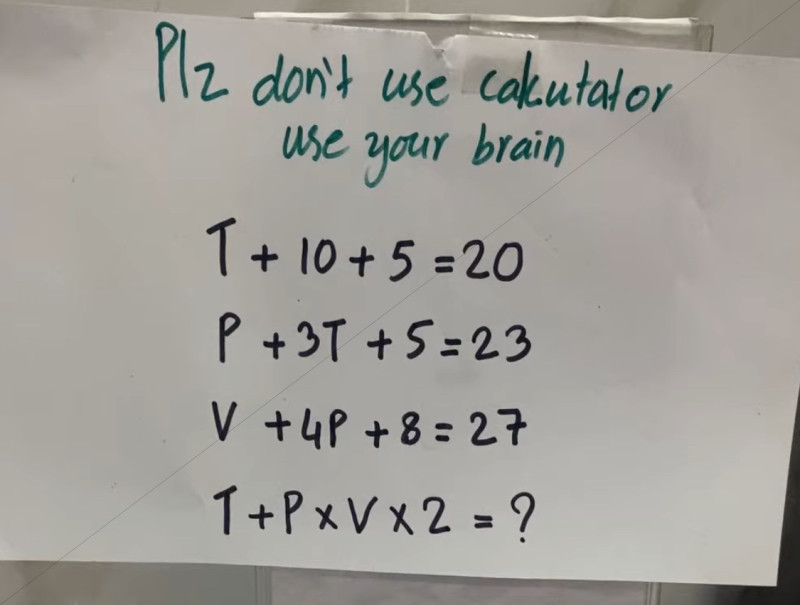
Solve the following system of equations and calculate the final expression without using a calculator: 1. T + 10 + 5 = 20 2. P + 3T + 5 = 23 3. V + 4P + 8 = 27 4. Find the value of T + P×V×2 = ?
Correct Answer
37
Detailed Solution Steps
1
Step 1: Solve for T using the first equation. Simplify T + 10 + 5 = 20 to T + 15 = 20. Subtract 15 from both sides: T = 20 - 15 = 5.
2
Step 2: Substitute T=5 into the second equation to solve for P. Replace T with 5 in P + 3T + 5 = 23, getting P + 3×5 + 5 = 23. Simplify to P + 15 + 5 = 23, then P + 20 = 23. Subtract 20 from both sides: P = 23 - 20 = 3.
3
Step 3: Substitute P=3 into the third equation to solve for V. Replace P with 3 in V + 4P + 8 = 27, getting V + 4×3 + 8 = 27. Simplify to V + 12 + 8 = 27, then V + 20 = 27. Subtract 20 from both sides: V = 27 - 20 = 7.
4
Step 4: Calculate the final expression T + P×V×2 using the order of operations (PEMDAS/BODMAS). First compute the multiplication: P×V×2 = 3×7×2 = 42. Then add T: 5 + 42 = 37.
Knowledge Points Involved
1
One-variable linear equation solving
A one-variable linear equation has the form ax + b = c, where x is the unknown. To solve it, isolate the unknown by performing inverse operations (addition/subtraction, multiplication/division) on both sides of the equation. Used here to find T, P, V one by one.
2
Substitution method for systems of equations
When solving a system of related equations, solve for one variable first, then substitute its value into the next equation to find the next unknown. This works when equations share variables, as seen by using T to find P, then P to find V.
3
Order of operations (PEMDAS/BODMAS)
A set of rules to determine the sequence of calculations: Parentheses/Brackets first, then Exponents/Orders, then Multiplication and Division (left to right), finally Addition and Subtraction (left to right). Critical here to avoid miscalculating the final expression by doing multiplication before addition.
Loading solution...