AI Math Solver
Resources
Questions
Pricing
Login
Register
Home
>
Questions
>
Solve the one-variable linear inequality 5x < 0 and graph the solution
Mathematics
Grade 7
Question Content
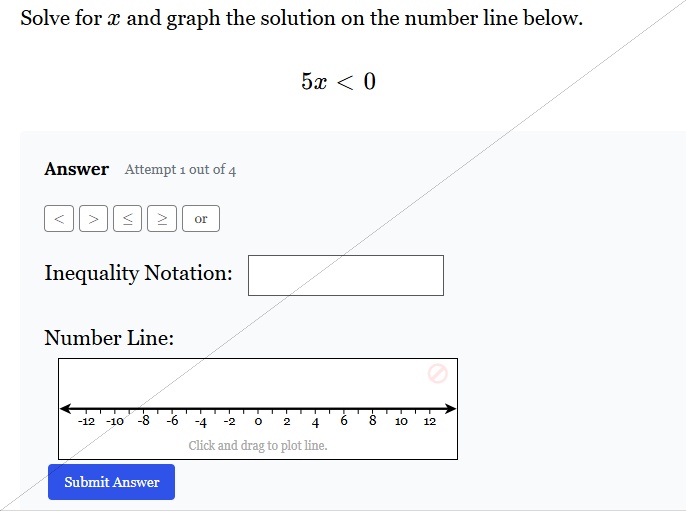
Solve for x and graph the solution on the number line. The inequality is 5x < 0.
Correct Answer
Inequality Notation: x < 0; Number Line: Open circle at 0, shaded line extending to the left towards negative numbers.
Detailed Solution Steps
1
Step 1: Isolate the variable x by dividing both sides of the inequality 5x < 0 by 5. Since 5 is a positive number, the direction of the inequality sign does not change: (5x)/5 < 0/5.
2
Step 2: Simplify both sides to get the solution in inequality notation: x < 0.
3
Step 3: For the number line graph: First, locate 0 on the number line. Since the inequality is strict (x is less than, not less than or equal to 0), draw an open circle at 0 to show 0 is not included in the solution. Then, shade the part of the number line to the left of 0, as all values less than 0 satisfy the inequality.
Knowledge Points Involved
1
One-variable linear inequality solving
A one-variable linear inequality is an inequality that can be written in the form ax + b < c (or using >, ≤, ≥). To solve it, use inverse operations to isolate the variable, similar to solving linear equations. When multiplying or dividing by a negative number, the inequality sign must be reversed; this rule does not apply when using positive numbers, as seen in this problem where we divide by positive 5.
2
Inequality notation
Inequality notation uses symbols < (less than), > (greater than), ≤ (less than or equal to), ≥ (greater than or equal to) to represent the set of all values that satisfy the inequality. For this problem, x < 0 is the correct notation to show all real numbers smaller than 0 are solutions.
3
Number line graphing of inequalities
When graphing inequalities on a number line: use an open circle for strict inequalities (<, >) to indicate the endpoint is not included in the solution, and a closed circle for non-strict inequalities (≤, ≥). Shade the portion of the number line that contains all values satisfying the inequality; shade left for < or ≤, and right for > or ≥.
Loading solution...