AI Math Solver
Resources
Questions
Pricing
Login
Register
Home
>
Questions
>
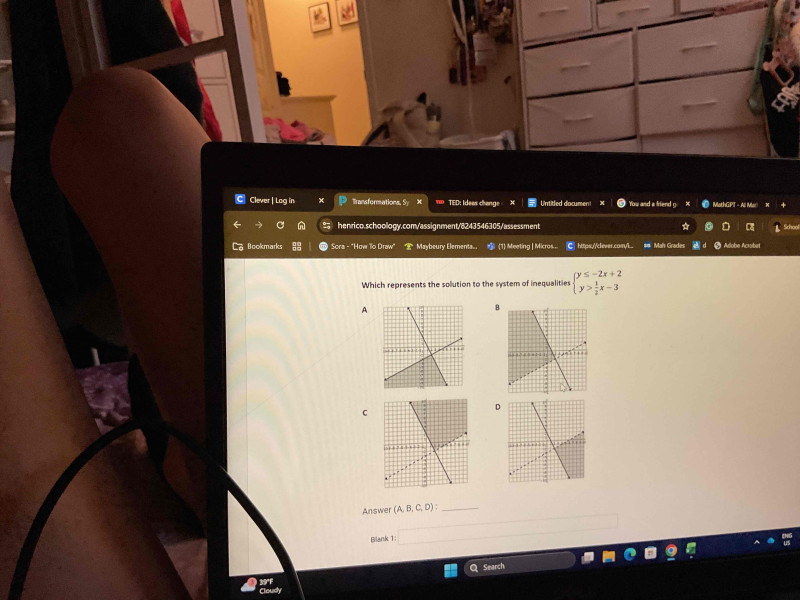
Solve the System of Linear Inequalities $y\\leq -2x + 2$ and $y> \\frac{1}{2}x - 3$ (Graph Choice Question)
Mathematics
Grade 9 (Junior High School)
Question Content
Which represents the solution to the system of inequalities $\begin{cases} y\leq -2x + 2 \\\\ y> \frac{1}{2}x - 3 \end{cases}$? Choose the correct graph from options A, B, C, D.
Correct Answer
Option A
Detailed Solution Steps
1
Step 1: Analyze the first inequality $y\leq -2x + 2$: \n- First, graph the boundary line $y=-2x+2$. Since the inequality uses $\leq$, the line will be solid (to include points on the line). \n- Test a point not on the line, like $(0,0)$: $0\leq -2(0)+2$ simplifies to $0\leq2$, which is true. So we shade the region that contains $(0,0)$, which is below the solid line.
2
Step 2: Analyze the second inequality $y> \frac{1}{2}x - 3$: \n- Graph the boundary line $y=\\frac{1}{2}x-3$. Since the inequality uses $>$, the line will be dashed (to exclude points on the line). \n- Test a point not on the line, like $(0,0)$: $0> \\frac{1}{2}(0)-3$ simplifies to $0> -3$, which is true. So we shade the region that contains $(0,0)$, which is above the dashed line.
3
Step 3: Find the overlapping shaded region: \n- The solution to the system is the area that is shaded for both inequalities. Comparing to the options, Option A shows the correct overlapping region: below the solid line $y=-2x+2$ and above the dashed line $y=\\frac{1}{2}x-3$.
Knowledge Points Involved
1
Graphing Linear Inequalities in Two Variables
This involves graphing the boundary line of the inequality (solid for $\leq$ or $\geq$, dashed for $<$ or $>$) and then shading the half-plane that satisfies the inequality, determined by testing a point not on the boundary line. Used to visualize the set of all solutions to a single linear inequality.
2
Solving Systems of Linear Inequalities
The solution to a system of linear inequalities is the intersection (overlap) of the solution regions of each individual inequality in the system. This overlapping region contains all coordinate pairs $(x,y)$ that satisfy every inequality in the system simultaneously.
3
Boundary Line Rules for Inequalities
Solid boundary lines are used when the inequality includes equality ($\\leq, \\geq$), meaning points on the line are part of the solution. Dashed boundary lines are used when the inequality does not include equality ($<, >$), meaning points on the line are not part of the solution.
4
Testing Points for Inequality Shading
To determine which half-plane to shade for an inequality, substitute a test point (usually $(0,0)$ if it is not on the boundary line) into the inequality. If the resulting statement is true, shade the region containing the test point; if false, shade the opposite region.
Loading solution...