AI Math Solver
Resources
Questions
Pricing
Login
Register
Home
>
Questions
>
Square Diagonal and Angle Calculation Problem with KM=25
Mathematics
Grade 8 (Junior High School)
Question Content
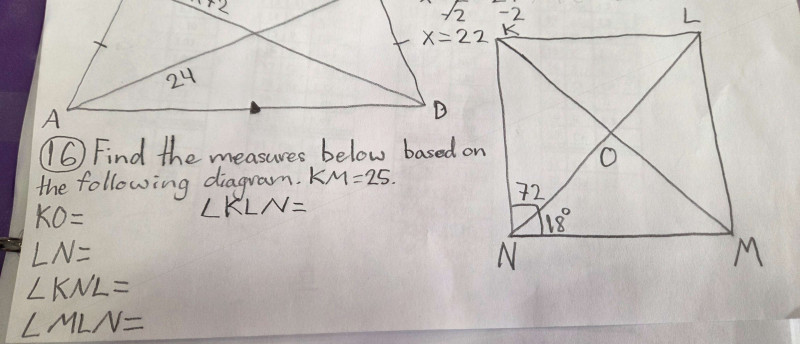
Find the measures below based on the following square diagram where KM=25. Calculate KO=, LN=, ∠KNL=, ∠KLN=, ∠MLN=
Correct Answer
KO=12.5, LN=25, ∠KNL=72°, ∠KLN=45°, ∠MLN=27°
Detailed Solution Steps
1
Step 1: Recall the properties of a square's diagonals. In a square, diagonals are equal in length, bisect each other, and bisect the square's interior angles (which are 90° each).
2
Step 2: Calculate KO. Since diagonal KM=25, and diagonals bisect each other, KO = KM/2 = 25/2 = 12.5.
3
Step 3: Calculate LN. Square diagonals are congruent, so LN = KM = 25.
4
Step 4: Calculate ∠KNL. The diagram shows ∠MNO=18°, and ∠KNM=90° (interior angle of a square). So ∠KNL = ∠KNM - ∠MNO = 90° - 18° = 72°.
5
Step 5: Calculate ∠KLN. Diagonal LN bisects the 90° interior angle ∠KLN, so ∠KLN = 90°/2 = 45°.
6
Step 6: Calculate ∠MLN. We know ∠KLN=45° and ∠KNL=72°, so ∠MLN = ∠KNL - ∠KLN = 72° - 45° = 27°.
Knowledge Points Involved
1
Properties of Square Diagonals
In a square, diagonals are equal in length, bisect each other (split each other into two equal segments), and bisect the square's 90° interior angles into two 45° angles. This applies to all squares and is used to solve for segment lengths and angle measures within the square.
2
Interior Angles of a Square
All four interior angles of a square are right angles, meaning they measure exactly 90°. This fixed angle measure is used to calculate related angles formed by diagonals or other lines inside the square.
3
Angle Subtraction for Composite Angles
When an angle is made up of two smaller adjacent angles, the measure of one smaller angle can be found by subtracting the known smaller angle from the total composite angle. This is used here to find angles formed by the diagonal and a secondary line inside the square.
Loading solution...